Industry analysis · Construction
Construction: a Monday WIP review from job-cost exports, with permits, price indexes and weather beside your jobs
The work-in-progress schedule says which jobs are over-billed, under-billed or heading for a loss. Here's how to build it from the job-cost export you already have, and what public data adds to the Monday conversation.
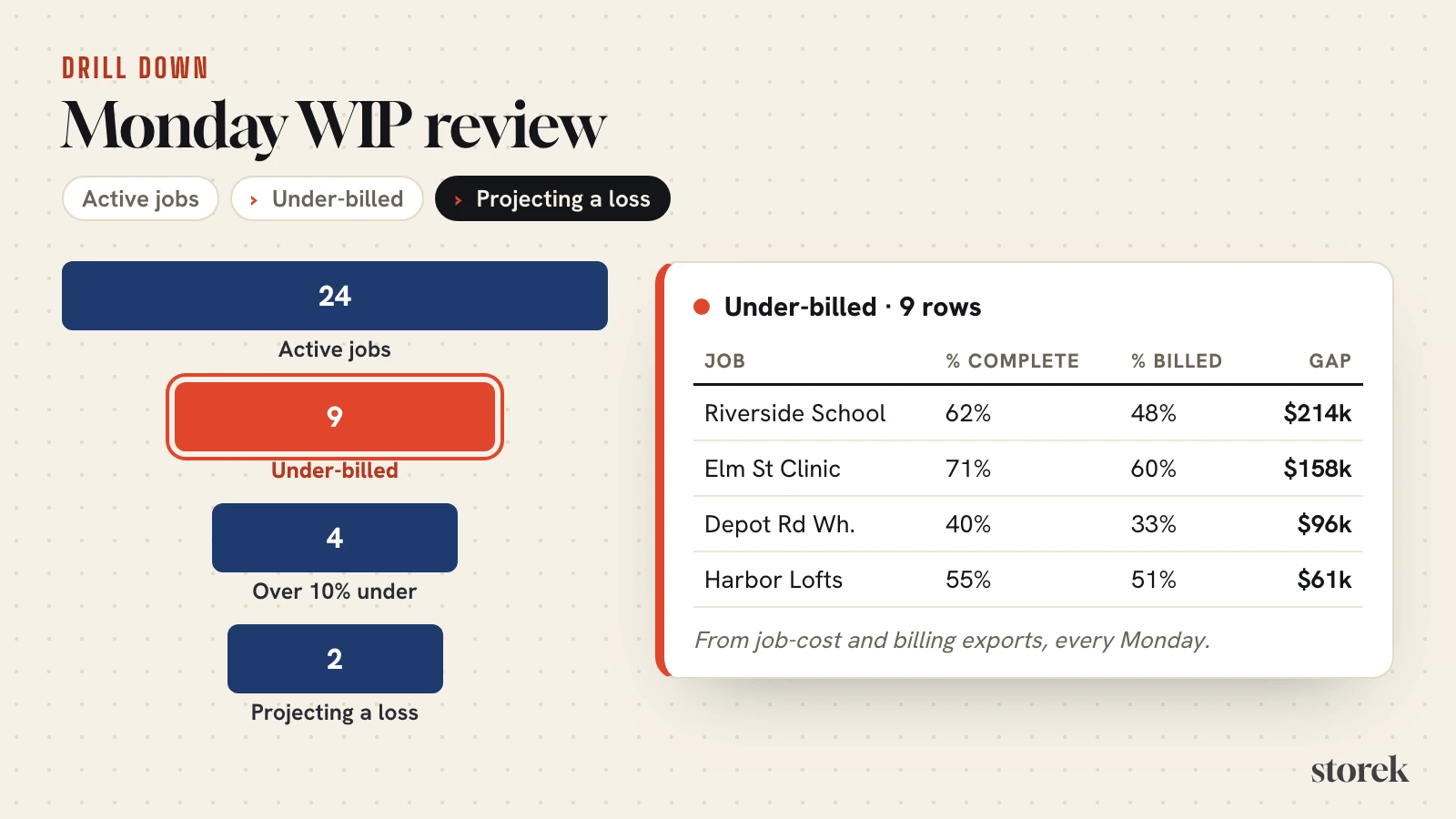
Monday morning, the controller and the project managers go through the work-in-progress schedule. Which jobs are behind on billing? Which are ahead? Is anything quietly turning into a loss? The answers come from the job-cost system, usually as an export that someone reshapes in a spreadsheet every week.
The math is not hard. The weekly rebuild is the part that eats the morning, and the part where mistakes slip in. This walkthrough uses an invented commercial contractor with six active jobs.
The WIP math in four lines
Most contractors use the cost-to-cost method for this:
- Percent complete = cost to date ÷ estimated total cost
- Earned revenue = percent complete × contract value
- Over/(under) billed = billed to date − earned revenue
- Projected margin = contract value − estimated total cost
Here are the six jobs, in thousands of dollars:
| Job | Contract | Est. total cost | Cost to date | % complete | Earned | Billed | Over/(under) |
|---|---|---|---|---|---|---|---|
| Elm St Medical | 12,400 | 11,160 | 6,250 | 56.0% | 6,944 | 7,158 | 214 |
| Harbor Logistics | 9,800 | 10,050 | 7,120 | 70.8% | 6,943 | 6,555 | (388) |
| Westview School | 8,600 | 7,740 | 2,180 | 28.2% | 2,422 | 2,518 | 96 |
| Pine Ridge Apts | 7,900 | 8,120 | 3,410 | 42.0% | 3,318 | 3,067 | (251) |
| Civic Garage | 5,300 | 4,720 | 3,950 | 83.7% | 4,435 | 4,292 | (143) |
| Mercer Retail | 4,200 | 3,760 | 1,140 | 30.3% | 1,273 | 1,133 | (140) |
Three things jump out. Harbor Logistics and Pine Ridge Apartments are estimated to cost more than their contracts, so they’re projecting a loss. Both are also under-billed, which makes the cash position worse. And Civic Garage is 84% done but under-billed by $143,000, which usually means a pay application is late. (Your accountant will treat loss jobs differently when the books are closed; this review only flags them.)
Building it from the export
Drop off the job-cost and billing exports
Upload the export as it comes out of the job-cost system: CSV or Excel, with each sheet becoming its own table. Storek checks the row count of every load against the source and fails loudly on a mismatch, so a short file doesn’t become a short WIP.
Ask the Monday questions
“Where are we under-billed on WIP this month?” “Which active jobs are trending over budget?” Each answer shows the SQL that ran, so the controller can check that percent complete was calculated cost-to-cost and not from a PM’s estimate field.
Pin the schedule and the tiles
Pin the answers into a dashboard: contract value, net over/(under) billing, jobs projecting a loss, and the billing position by job. Next Monday, the new export lands and every tile re-runs its checked query.
Work the exceptions as a review table
Put the jobs that need action into a table with a review workflow (Open, Accepted, In progress, Done), add a column for the PM’s note, and work through it in the meeting. Approved rows can be published as their own dataset for follow-up.
Send the summary
For the owner, a lender or the bonding company, export a branded PDF report with an executive summary, the findings and an appendix that lists every query and row count.
Context from public data
Your own jobs explain most of the WIP. Public data explains some of the rest. Storek’s catalog includes one-click public datasets such as building permits, a construction price index and weather, which can sit beside your job data in the same workspace.
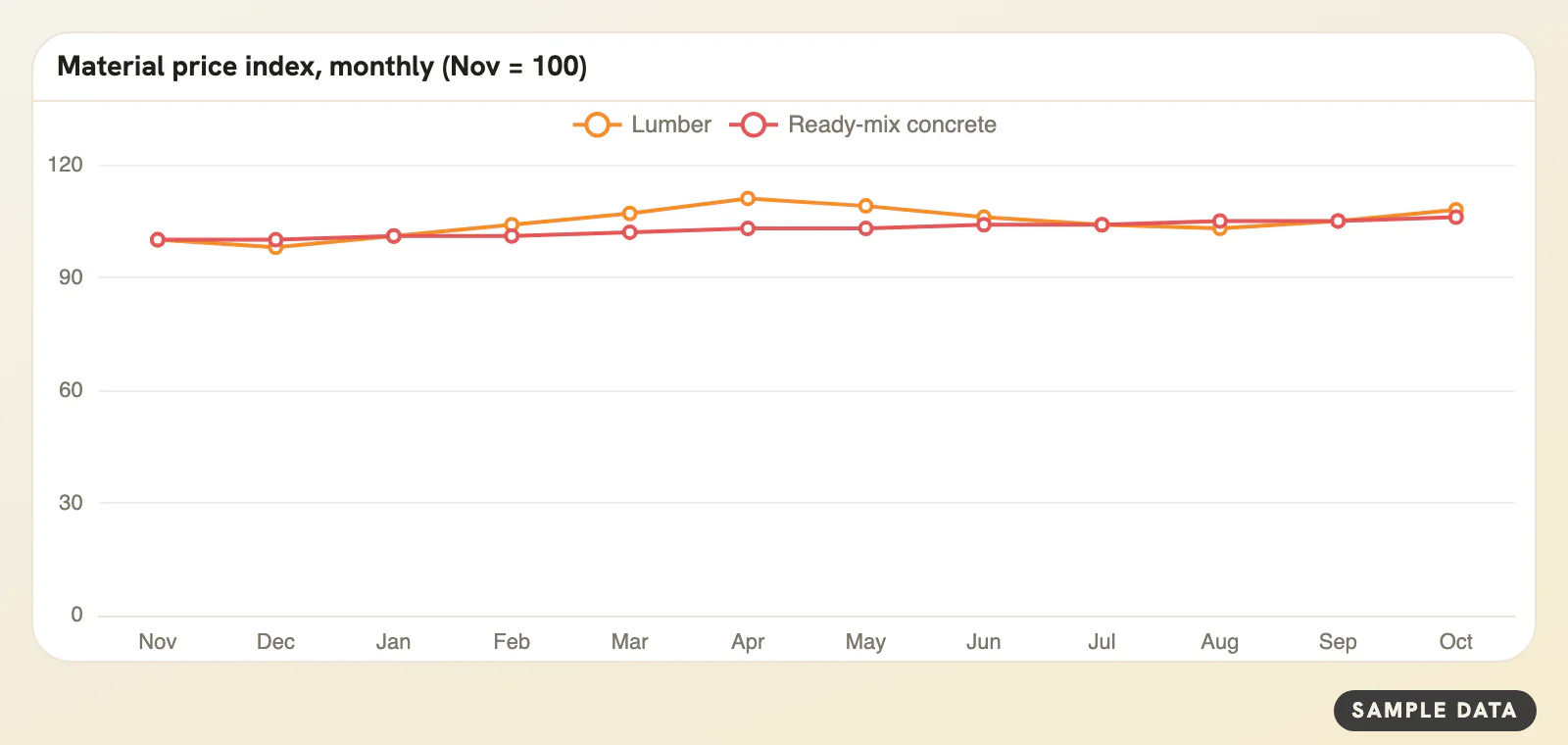
Material prices. If Pine Ridge’s estimate was built when lumber was cheaper, a rising index explains part of its overrun and tells you which other estimates to revisit.
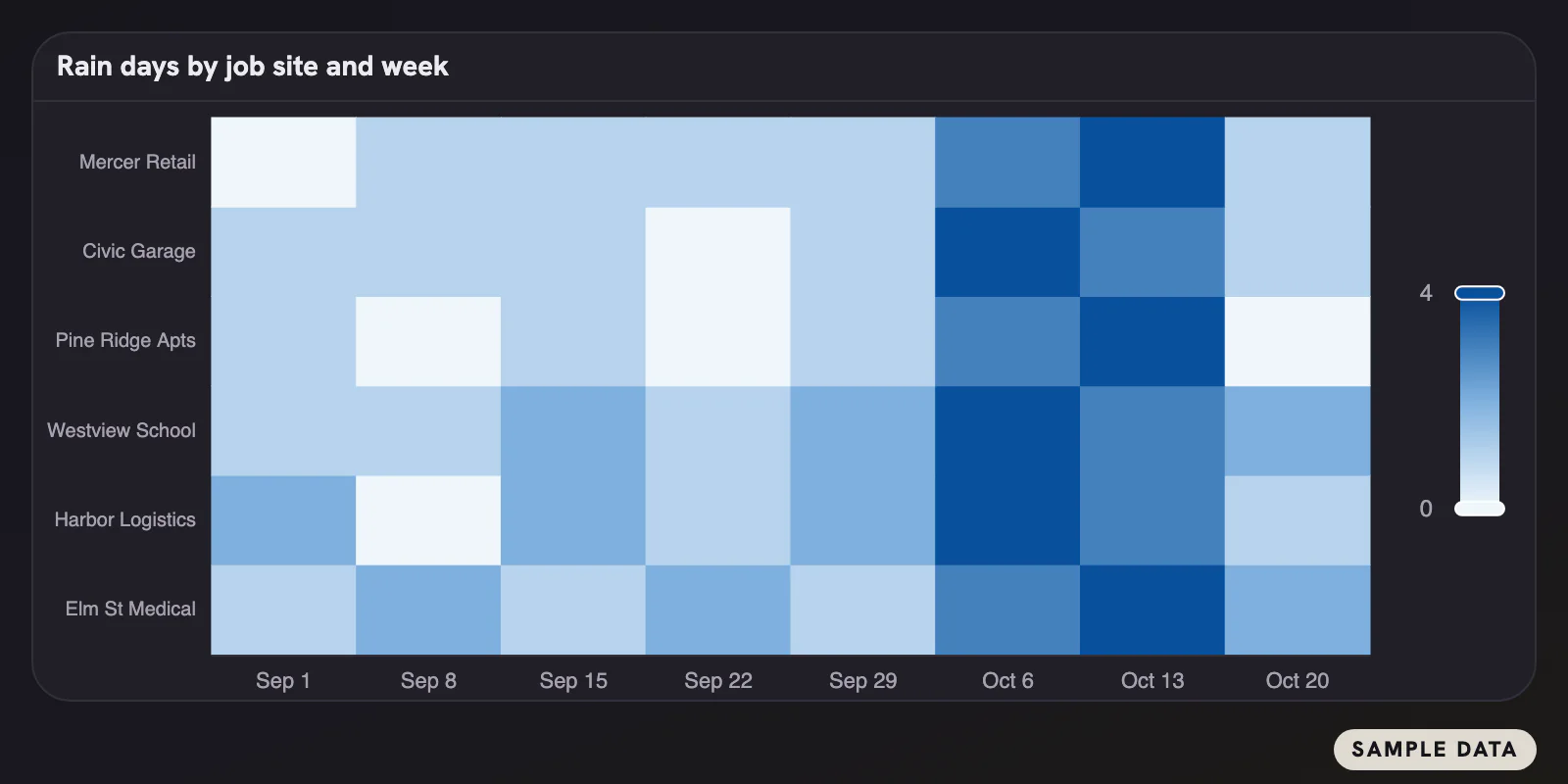
Weather. “Do rain days explain our slipped concrete pours?” is a question the construction team can now ask directly, by joining weather to job sites by place and week.
Permits. Permit volumes in your area show where the next bids are coming from, a different conversation from WIP but often the same meeting.
Crew data stays sealed
Job files carry personal data: crew phone numbers, owner contacts, subcontractor tax IDs, Social Security numbers on certified payroll. Storek finds them when data lands and masks them whenever anyone reads it. An SSN reads ***-**-6789, and tokenized worker IDs still join payroll to timecards, so labor cost by job stays correct without anyone seeing who’s who.