Platform how-to
Match on more than a name: combine name, city and email domain to find the same person or company across files
Two lists with no shared ID can still be matched, as long as you stop relying on the name alone. A few extra clues, checked together, turn guesswork into a match you can trust.
Grace organises training courses for Fernhill Learning, a company that runs workshops for small businesses. She has two lists: everyone who signed up through the website last year, and the attendance sheets from the workshops themselves, typed up by the trainers. She wants to know who signed up but never came, so she can invite them again.
Neither list has a customer number. So she matched on name. It looked fine at first, until she noticed that “Sam Patel” had apparently attended eleven workshops in four cities. There were, of course, several Sam Patels. Meanwhile “Katherine O’Neill” on the sign-up list and “Kate ONeill” on the attendance sheet were the same person, and the name match had missed her completely.
A name is a clue. It is rarely enough on its own.
Why a name alone lets you down
Names fail in both directions. Common names collide, so different people get merged. And the same person is written differently in different places, so real matches are missed. Here is a small slice of Grace’s lists.
| Sign-up list | Attendance sheet | Name match? | Really the same? |
|---|---|---|---|
| Sam Patel, Leeds, sam@brightlane.co | Sam Patel, Bristol, spatel@orchardvet.com | Yes | No |
| Katherine O'Neill, York, k.oneill@harrowdesign.com | Kate ONeill, York, kate@harrowdesign.com | No | Yes |
| Ben Ruiz, Leeds, ben@tidyhouse.co | Benjamin Ruiz, Leeds, b.ruiz@tidyhouse.co | No | Yes |
| Ana Silva, Bath, ana@silvaflowers.com | Ana Silva, Bath, ana@silvaflowers.com | Yes | Yes |
Look at what settles each case. The two Sam Patels are in different cities with different email domains. Katherine and Kate share a city and an email domain. Ben and Benjamin share both too. The extra clues do the work that the name could not.
Five tips for better matches
List every clue the two files share
Before matching, write down every column that appears in both files, even loosely: name, city, postcode, phone, email, company, job title. You will often find more overlap than you expected. A phone number in one file and a mobile number in the other may be the same thing.
Tidy each clue before comparing
Make names and cities the same case, remove punctuation like apostrophes and full stops, and trim spaces. Take the email domain, the part after the @, as its own column. Write phone numbers in one format. Small tidying turns “O’Neill” and “ONeill” into the same value.
Require at least two clues to agree
A simple rule beats a clever one. Treat two records as the same only when the name is close and at least one other clue matches, such as city or email domain. Two independent clues agreeing by chance is far less likely than one.
Know which clues are weak
Some values are shared by huge numbers of unrelated records. Free personal email domains, a big city, a common surname or a generic company name like “Consulting Ltd” should count for little. Give more weight to clues that are close to unique, such as a full email address or a registration number.
Send the unsure ones to a person
There will always be a middle band: same name and city but different email domains, perhaps after a job change. Do not force a decision. Put those rows in a short list and ask someone who knows the customers. It takes minutes and keeps wrong matches out of your reports.
A simple way to think about it
You can picture matching as a few gates. Each one lets through only the pairs that still look like the same record.
- Similar namemany candidates
- Same cityfewer
- Same email domainvery few
- Match, or askconfident or reviewed
What Grace found
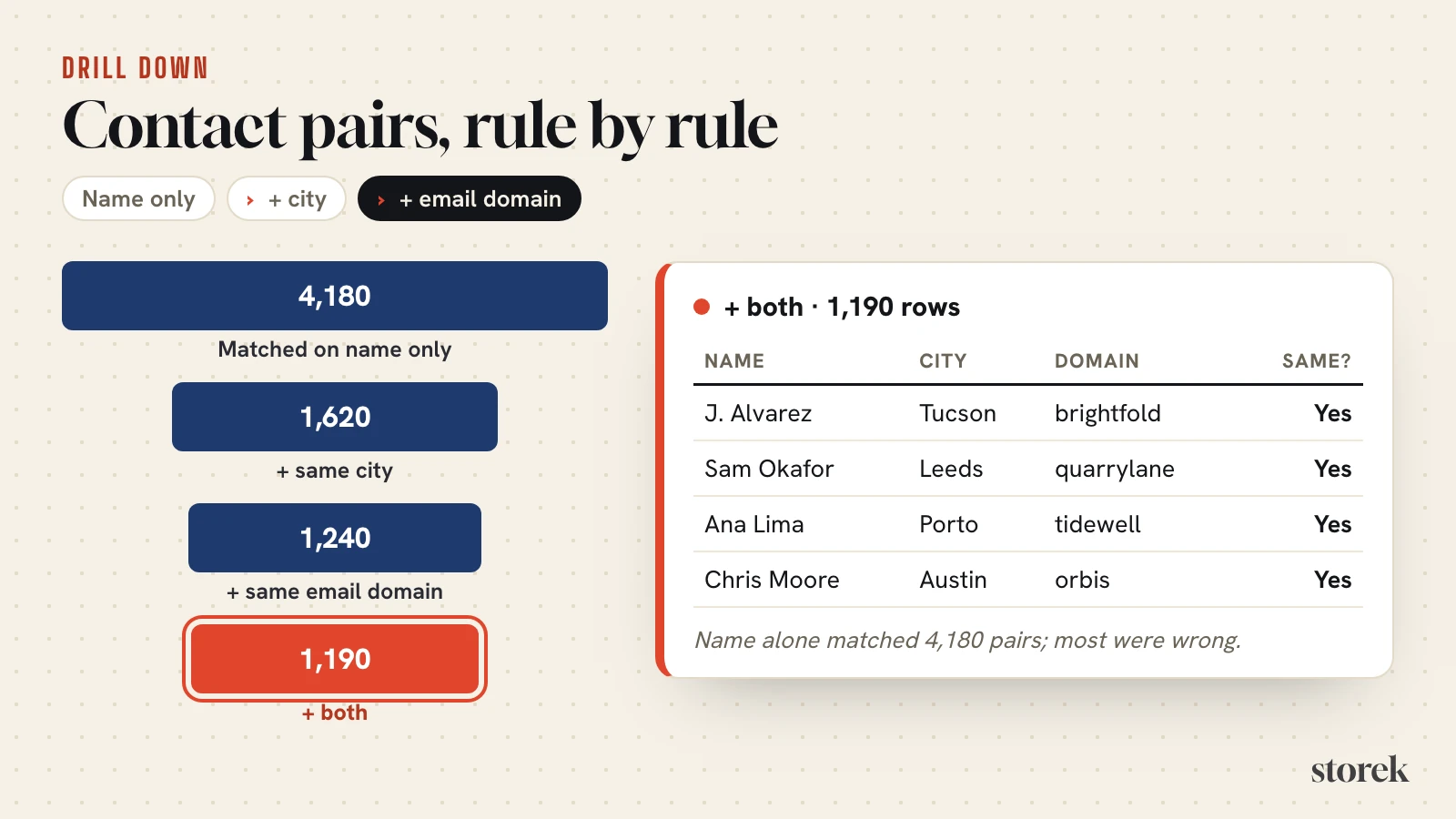
With a two-clue rule, the eleven-workshop Sam Patel turned into four separate people, each with a sensible history. Katherine, Ben and a dozen others who had looked like no-shows turned out to have attended under a slightly different spelling. The list of people to re-invite shrank, and every name on it was right. The chart at the top shows the general pattern on invented numbers: extra clues remove wrong matches and keep almost all the right ones.
How Storek helps
Storek compares several columns at once when it lines up records from different files, so a similar name, the same town and the same email domain count together as evidence. It recognises weak clues such as free email domains and gives them little weight. When a pair could go either way, it shows you the evidence and asks, rather than quietly merging two people. Your own tidy columns make its job easier, and its questions keep the final call with you.