Platform how-to
When only one person knows how the report is built: find the hidden steps and write the recipe down
Every team has a report that only one person can produce. It works fine until they're on holiday the week it's due. The fix isn't a better spreadsheet; it's getting the hidden steps out of one head and into a recipe anyone can run and check.
When only one person knows how a report is built, the risk is not the spreadsheet. It is the handful of steps that live in their head: the codes they fix by hand, the accounts they always remove, the definition they apply without thinking. To fix it, have someone else build the report while the owner watches, write down every step that needed asking about, turn those steps into a recipe with check numbers, and rotate who runs it. The goal is a report anyone on the team can produce and check.
This is often called the bus factor: how many people would have to be unavailable before the work stops. For a lot of monthly reports, the answer is one.
How it shows up
Halden Supply distributes plumbing parts to trade customers. Jo, the finance manager, has built the monthly board pack for three years. In August Jo took two weeks off, and the pack was due in the middle of them.
Ravi from sales operations pulled the same three exports Jo uses and built the charts from Jo’s last workbook. Revenue came out 6% higher than July. The board asked why. Nobody knew until Jo came back and spotted it in a minute: Ravi had not removed the internal and test accounts, and two regions had been counted twice because their codes changed in the spring.
Nothing was broken. Two steps had simply never been written down.
Step 1: find the hidden steps with a shadow run
The quickest way to find what is in someone’s head is to watch someone else get stuck. Pick a month that is already done, so there is a right answer to compare with. A colleague builds the report from scratch. The owner sits beside them, says nothing, and answers only when asked. Every question is a hidden step.
At Halden, the shadow run took an afternoon and produced this:
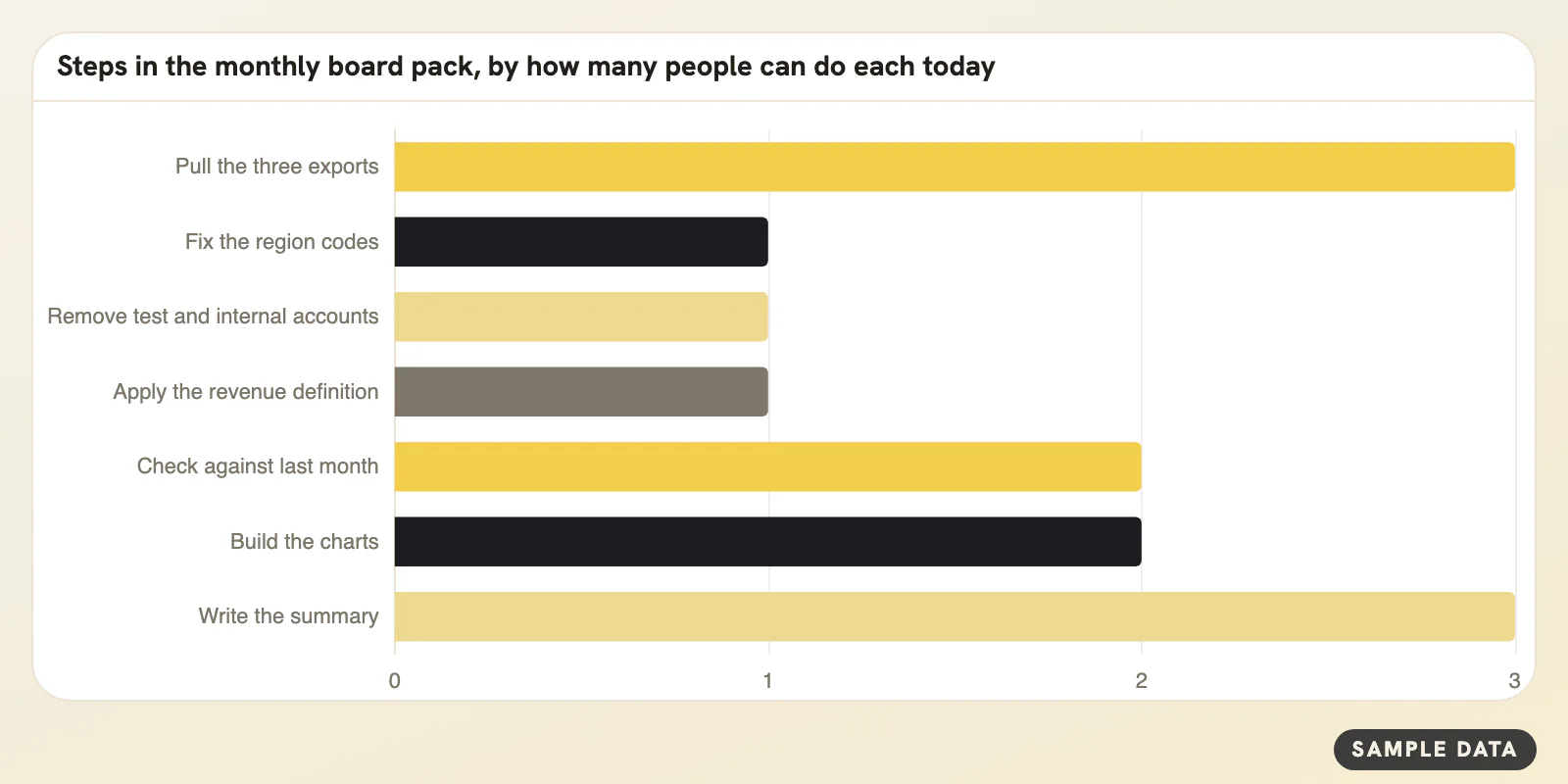
The steps everyone could do were the visible ones: pulling exports, building charts, writing the summary. The steps only Jo could do were the ones that change the numbers.
Step 2: write the recipe
A recipe is not a manual. It is one page that lets a capable colleague produce the same numbers. It needs five parts.
| Part | What it says | Halden example |
|---|---|---|
| Sources | Where each file comes from, which filter, which dates | Orders export, all branches, invoice date in the month |
| Steps | Every change to the data, in order | Map old region codes to new ones before totalling |
| Definitions | The meaning of each number, with the date it was agreed | Revenue: invoiced, net of credit notes, excluding internal accounts |
| Known quirks | What looks wrong but isn't, and what looks fine but is | Two test accounts start with ZZ; one real customer does too |
| Checks | Three or four numbers the finished report must match | Order count matches the order system's own monthly total |
The known quirks row is where most of the value is. It holds the things the owner has stopped noticing because they deal with them every month. The Halden example shows why a rule of thumb isn’t enough: removing every account starting with ZZ would also remove a real customer.
Step 3: move the steps out of people and into data
Some steps can be written down. Better still, some can stop being steps at all.
Replace hand fixes with a lookup
Jo fixed region codes by memory. Now a small two-column table maps old codes to new ones, and the report joins to it. When a code changes again, someone adds a row, not a habit.
Keep exclusion lists as files, not rules of thumb
The internal and test accounts became a named list with a reason for each. Anyone can read it, and anyone can see when it last changed.
Put the checks next to the result
The finished pack now shows the check numbers beside the totals. If the order count doesn’t match the order system’s, the reader sees it before the board does.
Our guide to a weekly report from exports, built once covers turning these steps into something that runs the same way every time. And if two versions of the same number are already circulating, why dashboard numbers don’t match the spreadsheet shows how to settle which one is right.
Step 4: rotate who runs it
A recipe that nobody else uses drifts back into one head within months. Have a second person run the report every second or third month, with the owner available but not driving. Each rotation either confirms the recipe or adds the step that had crept back in. At Halden, Ravi now runs the pack every third month, and the September rotation found one new quirk: a branch that had started invoicing on the first of the following month.
How Storek helps
In Storek, the parts of the recipe that change numbers live in the workspace rather than in one person’s head. Each metric has one written definition, versioned, with the reason for every change, and every answer and chart uses it. Every answer shows its working, so anyone can see how a figure was counted and check it, not just the person who built it. Anyone on the team can ask in plain words, pin the answers that matter to a dashboard that stays current as the data refreshes, and send a branded report whose appendix lists how each figure was worked out and the rows behind it.
A free 30-day pilot on one report, such as the monthly pack only one person can build, is a fair test. Book a demo and bring the report you’d least like to rebuild from scratch.