Platform how-to
Questions, not queries: how plain-word questions get trustworthy answers, and how to check them
The people with the best questions are rarely the people who write queries. Plain-word questions close that gap, as long as every answer shows its work and nothing is guessed.
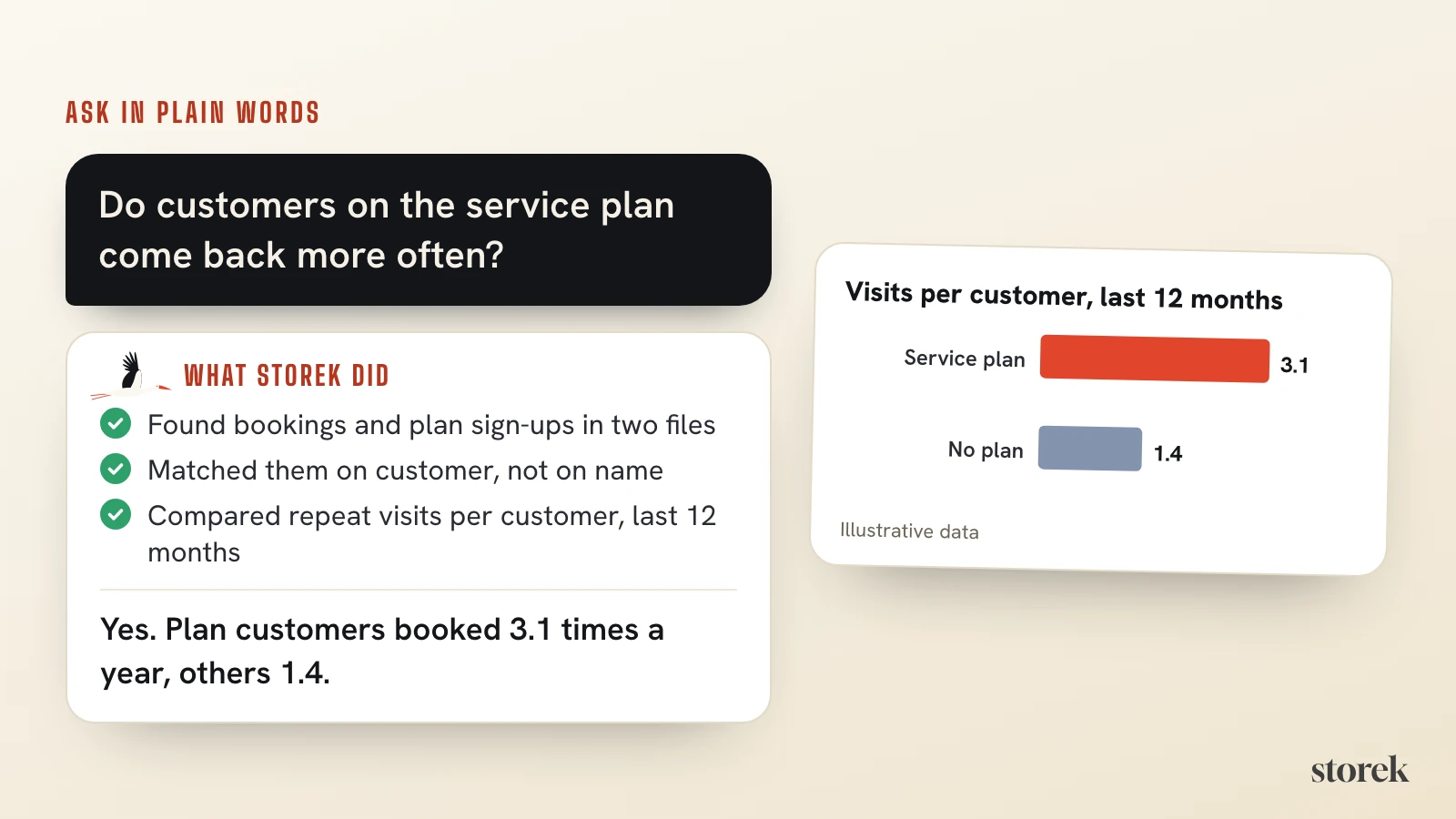
At Spoke & Chain, a small chain of bike shops, the person with the best questions is Leah, who runs the service desk. She notices things: customers on the annual service plan seem to come back more often, and the shop by the river seems busier on wet weekends. She has hunches every week, and most of them are about which customers come back and why. She does not write queries, and the one person who does is busy.
So the hunches stay hunches. This is the quiet cost of data that only specialists can ask: the questions that matter most never get asked at all.
A question is not a query
A question is what a person wants to know: “do service-plan customers come back more often?” A query is the precise instruction a database needs: which tables, which joins, which filters, which time window. Turning one into the other used to be a skill, and it still is. The difference now is that the translation can be done for you, as long as it is done carefully.
Careful is the important word. Anyone can build something that turns words into a query in an afternoon. Making that safe to rely on is the real work, and it comes down to a few habits.
Tie the words to the data
“Service plan” has to mean something real in the data, such as a product line called Annual Care. If the word could mean two things, the right response is a short question back, not a pick.
Say no when the data is not there
Ask about a “premium plan” when no such plan exists and the honest answer is that there isn’t one, followed by the plans that do exist. A close match is not an answer.
Show the method
Every answer should say in plain words what was counted, over which period, and how the tables were joined, with the exact query underneath for anyone who wants it.
Keep the meaning once it is agreed
When the team settles what “comes back” means, say another paid visit within a year, that definition is written down and every later answer uses it.
Leah’s question, answered
Leah types: “Do customers on the service plan come back more often than everyone else?”
The data behind it is spread out: sales from the till system, service jobs from the workshop booking tool, and the plan sign-ups from a spreadsheet. Storek has already mapped how they connect through the customer’s phone number and loyalty ID, so the question can be answered across all three.
What comes back is a chart of repeat visits for plan customers and for everyone else, week by week, with a short method beside it: who counts as a plan customer, what counts as a return visit, which shops are included. Leah does not need to read the query. She needs to know it is there, and that the shop manager could read it if he wanted to.
From one answer to a habit
- Askin plain words
- Checkmethod and query
- Pinto a dashboard
- Shareon a whiteboard
The first answer is the start, not the end. Leah pins the chart to the service-desk dashboard, where it redraws itself whenever new sales land. For the monthly meeting she puts it on a whiteboard next to a note about the wet-weekend pattern, and the team decides to offer the plan at checkout on rainy days.
None of this needed a data team. It needed the data to be connected, the words to be tied to real values, and every answer to show its work.
How to start asking
Pick three questions your team has been carrying around as hunches. Ask them exactly as you would ask a colleague. For each answer, open the method and check it against something you already know. Where a word turns out to be ambiguous, settle its meaning once and save it.
Those small checks are what turn plain-word questions from a party trick into something a team can run on, week after week, without a specialist in the loop for every new idea. The questions were always the valuable part. Now the people who have them can ask.