Platform how-to
Acme Inc., ACME, Acme Incorporated: how to spot the same customer spelled three ways and bring the records together
When one customer appears under several spellings, every report undercounts them. The fix is a little patience and a short list of rules, applied in the right order.
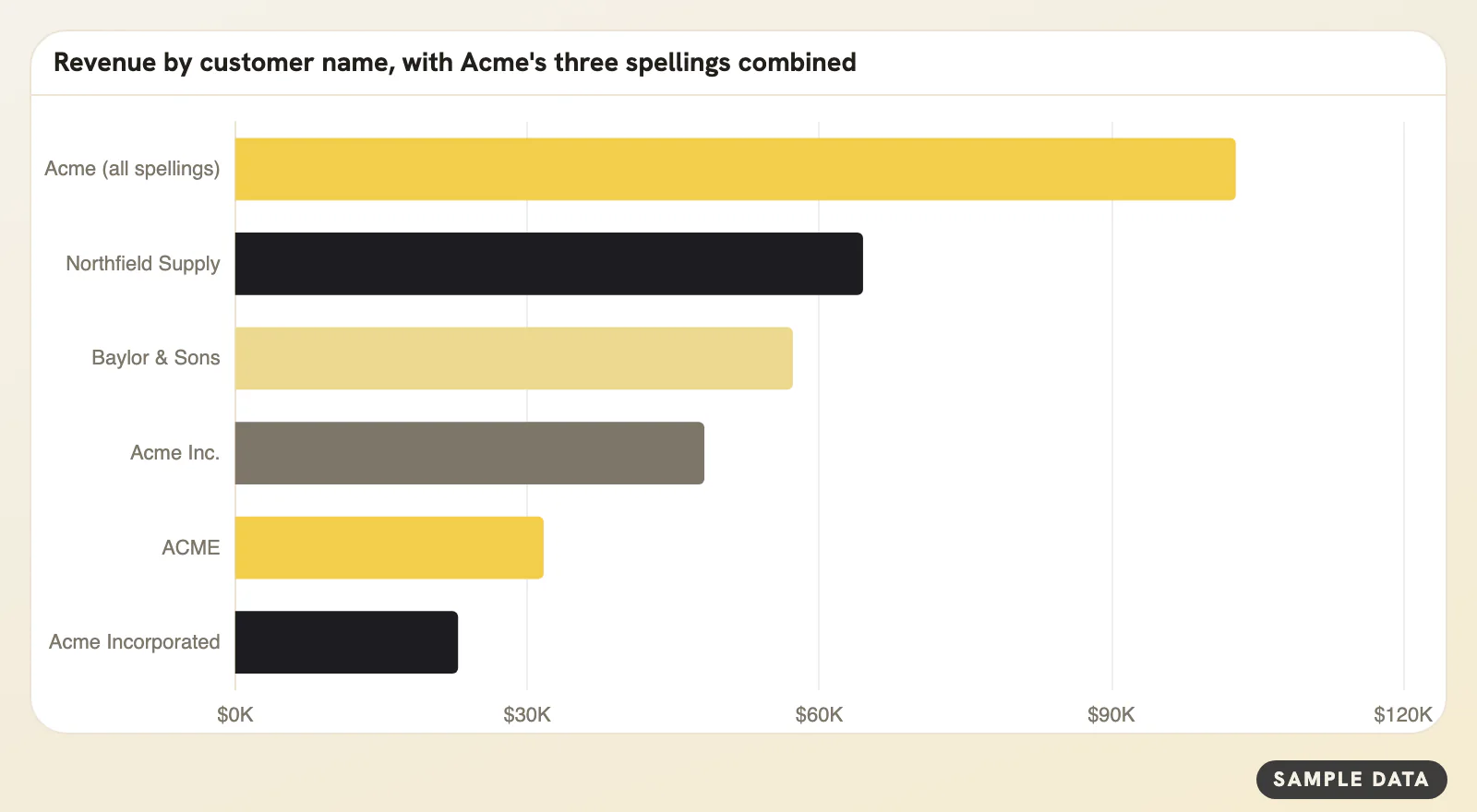
Marcus looks after key accounts at Copperline Packaging, which makes boxes and labels for food producers. At the end of the year he pulled a list of top customers by revenue, to decide who deserved a visit and a thank-you lunch.
Acme was nowhere near the top. That seemed odd. Acme ordered almost every week. Then he scrolled further down and found “ACME” a few rows below, and “Acme Incorporated” further still. Three salespeople, three systems, three spellings. Added together, Acme was not a mid-sized account. It was Copperline’s biggest customer, and it had nearly been left off the lunch list.
Every business with more than one system has a few customers like this. Finding them is mostly a matter of knowing which differences to ignore.
What the variants look like
Here are some of the names Marcus found once he started looking.
| Name as recorded | Where | Same customer as |
|---|---|---|
| Acme Inc. | Sales orders | Acme |
| ACME | Invoicing | Acme |
| Acme Incorporated | Delivery system | Acme |
| Acme Inc (Rotterdam) | Sales orders | Acme, Dutch branch |
| Acme Signs Ltd | Invoicing | A different company |
The last two rows are the important ones. A careless cleanup would merge all five and give Acme revenue that belongs to a sign maker down the road.
Six tips for finding and combining spellings
Make a comparison copy of the name
Never edit the original name. Make a second column for comparing, then change the copy: make it all one case, remove punctuation, and collapse double spaces. “Acme Inc.” and “ACME INC” already become the same.
Remove the legal suffixes from the copy
Words like Inc, Incorporated, Ltd, Limited, LLC, GmbH, Co and Corp say what kind of company it is, not which company. Strip them from the comparison copy. Do the same with a leading “The”. Now “Acme Incorporated” and “ACME” both read “acme”.
Sort and scan
Sort the list by the comparison copy. Variants land next to each other, and a person can scan a few hundred names in minutes. This simple step finds most of the duplicates in a typical customer list.
Confirm with a second clue
Before combining, check that something else agrees: the same email domain, the same address, the same account manager or tax number. “Acme Signs” and “Acme” share a word but nothing else, so they stay apart.
Keep a list of which spelling belongs to whom
Write the decisions into a small two-column table: every spelling on the left, the one customer it belongs to on the right. Apply it whenever you build a report. Next quarter, when “Acme Inc” turns up again, the list already knows the answer.
Decide what to do with branches
A branch or regional office may be the same company but a different customer for your purposes. Rather than merging or splitting by habit, keep both: the branch as its own customer, and a “parent” column that rolls it up when you want the whole picture.
From many spellings to one customer
- Three spellingsAcme Inc., ACME, Acme Incorporated
- Comparison copyacme, acme, acme
- Second clue agreessame email domain
- One customeroriginals kept
The list Marcus ended up with
After an afternoon with the comparison copy and a sort, Marcus found eleven customers recorded under more than one name. Four of them moved into his top twenty. Two pairs that looked alike turned out to be unrelated businesses and stayed apart, because their email domains and addresses did not match. The chart at the top of this page shows the effect on invented figures: three short bars become one long one.
He also kept the mapping list. It now sits beside the customer export, and the monthly report applies it automatically before anything is totalled.
How Storek helps
Storek notices when names in your files differ only by case, punctuation or a legal suffix, and checks other columns, such as email domain or address, before treating them as one customer. Clear cases are combined, with the original spellings kept and the decision written down. Unclear ones, like a shared name with no other clue in common, come back to you as a question. You stay in charge of who counts as the same customer.