Platform how-to
Do you need a data team to get answers from your data?
You need someone to own the questions and a few written definitions. You don't need a department. Here is what analytics without a data analyst looks like in practice.
No, most small companies do not need a data team to get real answers from their data. They need three things: one person who owns the questions, the data gathered somewhere it can be joined, and a few definitions written down so everyone counts the same way. A data team becomes worth hiring when the questions outgrow one person’s week, or when the business needs models and pipelines built to order.
That is the short answer. The rest of this piece shows what analytics without a data analyst looks like at a real-sized company, what to do in the first week, and where the approach runs out.
What a data team actually does
It helps to split the job into parts. A data team, even a team of one, usually does four things:
| Job | What it means | Do you need a specialist? |
|---|---|---|
| Gather | Pull exports and system data into one place | Rarely; this is mostly routine |
| Connect | Work out how tables join: customer IDs, job numbers, emails | Not if the links can be found from the values |
| Define | Agree what a metric means and write it down | No; this is a business decision |
| Ask and check | Turn a question into a query and test the result | Less and less, if every answer shows its working |
Notice the third row. Deciding what counts as an “active customer” or a “repeat visit” is never a technical call. An analyst would have to ask you anyway. The parts that did need a specialist were gathering, joining and writing queries, and those are the parts tools now handle well.
A worked example: Kestrel Heating & Air
Kestrel is a heating and cooling service company with 34 staff. Dana, the operations manager, has a hunch that technicians are going back to the same houses too often. Callbacks cost a truck, a tech and an unhappy customer. Nobody at Kestrel writes queries.
Her data lives in four places: the job management system (every service call, with technician and equipment model), the billing system (invoices and whether a job was billed), the phone support log (every inbound call), and a spreadsheet of maintenance-plan customers that the office manager keeps by hand.
Here is how she got from a hunch to a fix.
Write the question in plain words
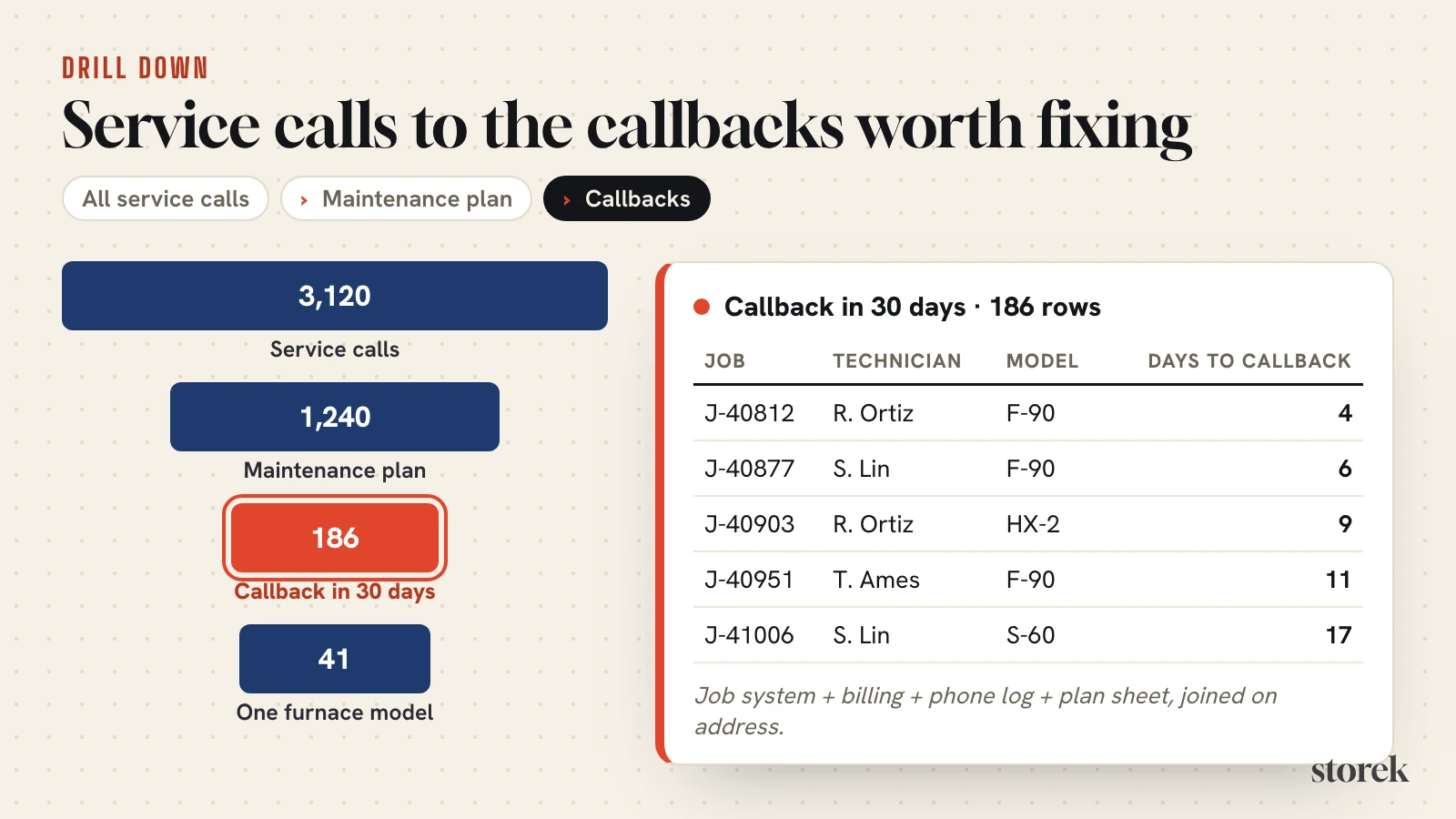
“How many service calls are followed by another call to the same address within 30 days, and is it worse for any technician or furnace model?” Writing it down forced one decision early: a callback is a second visit to the same address within 30 days, for any reason except a scheduled maintenance visit.
Gather the four sources
She exported the last six months from the job system, billing and the phone log, and added the maintenance spreadsheet as it was. No cleaning first.
Check how they connect
The job system and billing share a job number. The phone log only has a phone number, and the spreadsheet has a customer name and street address. The address was the join that mattered, and it needed tidying: “12 Elm St” and “12 Elm Street” are the same house.
Ask, then check against something known
The first answer said 3,120 service calls in six months. Dana knew the billing system showed 3,104 billed jobs, and the gap was 16 warranty calls that are never billed. That small check is what let her trust everything after it.
Narrow to what you can act on
1,240 calls were for maintenance-plan customers. 186 of those had a callback within 30 days. 41 of the 186 were on one furnace model, mostly the same ignition fault.
| Furnace model | Calls | Callbacks | Most common fault |
|---|---|---|---|
| Model F-90 | 212 | 41 | Ignitor |
| Model HX-2 | 388 | 29 | Thermostat wiring |
| Model S-60 | 301 | 18 | Filter |
| All others | 339 | 98 | Mixed |
The fix was not a dashboard. It was a parts change: trucks now carry the newer ignitor for that model, and techs replace it on the first visit. Dana kept the callback question as a weekly tile so she can see whether the rate falls.
What made it work without an analyst
Look back at the steps. Not one of them needed a query written by hand. What they needed was judgment:
- A precise question. “Too many callbacks” became a definition with a time window and an exclusion.
- One known number. Comparing to billing caught the warranty gap and built trust in a minute.
- A definition kept once. When Dana’s manager asked the same question a month later, the answer used the same 30-day rule, not a new guess.
These are owner skills. Most managers already have them; they simply never had a way to ask the data directly. If your questions do go to an analyst today, why every data question takes two weeks shows where the waiting comes from and how to cut it.
Your first week
Day 1: list five questions
Pick the ones your team argues about. “Which customers cost us more to serve than they pay?” beats “show me our KPIs”.
Day 2: map each question to its source
For every question, name the file or system that holds the answer and the person who knows it best.
Day 3: gather and connect
Put the exports in one place and confirm the joining fields: customer ID, job number, email, address.
Day 4: ask and check
Ask each question once. Compare one figure per answer with a number you already trust.
Day 5: write the definitions down
One sentence per metric: what it counts, what it leaves out, which date it uses.
How Storek helps
Storek is built for the company in this story. You drop in spreadsheets and connect business systems such as a CRM, billing or a support desk, and it works out how the tables connect from the values themselves. You ask in plain words, and every answer arrives with its working: the method in plain language and the exact query behind it. Definitions are written down once, and a verified answer re-runs the same checked query next time, so the callback rate in March means the same thing in June. It also suggests what to ask next and names what is missing, such as a fault column that is half empty.
If you want to try this on your own data, a free 30-day pilot covers one business area with success criteria agreed on day one. For a walk-through on data like yours, book a demo.