Platform how-to · Banking and credit unions
Claims filed soon after a policy starts or changes: a simple, fair screen for early-loss claims
A policy bought on Monday, a claim on Thursday. Sometimes it is bad luck. Sometimes cover was bought for a loss that had already happened. The data can tell you which claims to read first.
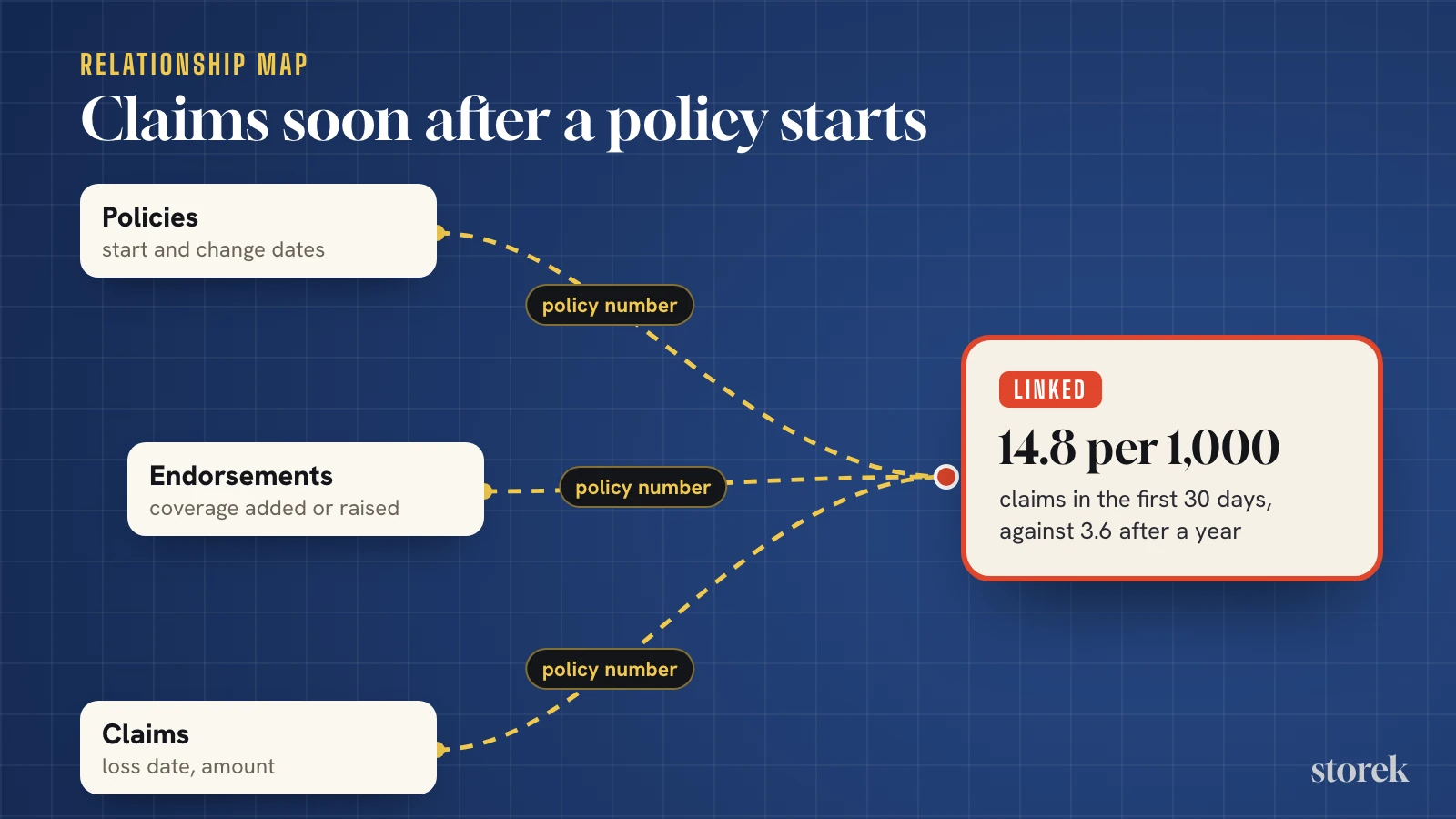
Brightwater General writes home and contents cover through brokers and online. Its head of claims, Marcus Oyelaran, kept hearing the same story from adjusters: a jewellery limit raised on a Tuesday, a burglary on the Saturday. Every adjuster had one. Nobody knew whether it was three claims a year or three hundred.
Why early claims are hard to count
The claim knows its loss date. The policy knows its start date. But the change that raised the jewellery limit is a separate record, an endorsement, often in a different table or even a different system. A claims report shows claim dates; a policy report shows start dates. Neither shows the gap between the most recent increase in cover and the loss.
Measuring the gap
You ask: How often are claims filed within 30 days of a policy starting or its cover being raised, compared with later in the policy?
What Storek did
Linked claims to cover
Matched each claim to its policy by policy number, and to every endorsement on that policy by policy number and date.Found the latest increase
For each claim, took the most recent event that increased cover before the loss: the start date, a higher limit, an added item or vehicle.Compared fairly
Counted claims per 1,000 policies in each age band, so a band with more policies is not flagged just for being bigger.
The answer
The first 30 days carry about four times the claim rate of older policies. Some of that is honest; the question is where the rest comes from.
Dig deeper: how Storek found this
Sources linked. The policy file, the endorsement history, the claims list and the broker list. Policy number links them all; broker code links policies to brokers.
Duplicates and variants. Policies renewed under a new number were joined to their previous number, so a renewal is not mistaken for a brand-new customer. Endorsements entered twice on the same day were counted once.
Peer comparison. Each product was compared with itself: new contents policies against older contents policies, not against motor. Brokers were compared with other brokers selling the same product.
What was masked. Policyholder names, addresses and contact details. The team sees dates, products and amounts.
Drilling down. Click the 0–30 bar to see every early claim with its product, the change that started the clock, days to loss, amount, broker and a link to the adjuster notes.
Where early claims cluster
You ask: Which products and changes produce the most early claims, and through which channel?
| Change before loss | Early claims | Rate vs mature policies |
|---|---|---|
| New policy, online | 184 | 2.1x |
| New policy, broker | 92 | 1.8x |
| Valuables limit raised | 47 | 9.4x |
| Vehicle added | 39 | 2.6x |
Raised valuables limits stand out far more than new policies. That is where Marcus asked his team to read first.
A fair early-claims screen in five steps
- Define “early” once. Pick 30, 60 or 90 days and write it in your shared definitions.
- Start the clock at the latest increase in cover, not only at the policy start.
- Compare like with like: product with product, channel with channel.
- Look for a second signal. An early claim with a shared bank account, as in same phone, different claimant, is a stronger lead than an early claim alone.
- Ask for documents, not confessions. Receipts and photos settle most early claims in the claimant’s favour.
Early timing is one of the signals in claims fraud red flags across systems, and it rises after big events too, as seen in catastrophe claim surges.
What a fair review looks like
When an early claim lands on Marcus’s list, the first step is always the same: read the file as if the claim is genuine, because most are. A new homeowner who discovers a leak in their first month is not suspicious; they are exactly the person the policy was bought for. The team checks whether the damage is consistent with the date, whether the cover was in place at the time, and whether any second signal is present.
Only claims with a second signal move to a closer look, and even then the request is for documents, such as photos, a repair quote or a receipt. Marcus asks his team to write down how each early claim closed. Over a few months, that record shows which products and channels produce early claims for honest reasons, so the screen can be tuned to bother fewer genuine customers.
From a hunch to a number
Marcus now has a number to replace the anecdotes, and a weekly list his team reads together. Storek links policies, endorsements, claims, billing and notes, masks personal data, and flags patterns for a person to review. See how it fits financial services teams.