Platform how-to · Banking and credit unions
Same phone, different claimant: finding the addresses, phones and bank accounts that connect unrelated insurance claims
Two claimants with different names, different policies and different adjusters. The same mobile number. Shared details are one of the quietest links between claims, and one of the easiest to miss.
At Fenwick & Vale Assurance, an adjuster named Priya Raman noticed something on a Friday afternoon. The claimant on her water-damage file gave a mobile number she was sure she had dialled before, on a different claim, under a different name. She searched her own files and found it. She had no way to search anyone else’s.
That moment happens in every claims team. Someone remembers a detail. Most of the time nobody can check it, so it is forgotten.
Why shared details hide
Each claim is entered on its own. The claimant’s phone, address and payment details sit on that claim, typed by different people in different ways: “07700 900 123”, “+44 7700900123”, “7700-900-123”. A claims system searches for exact matches inside its own records, and bank details often live in billing, not claims at all.
So the question “does this phone, address or account appear anywhere else under another name?” has no button to press.
Finding the details that repeat
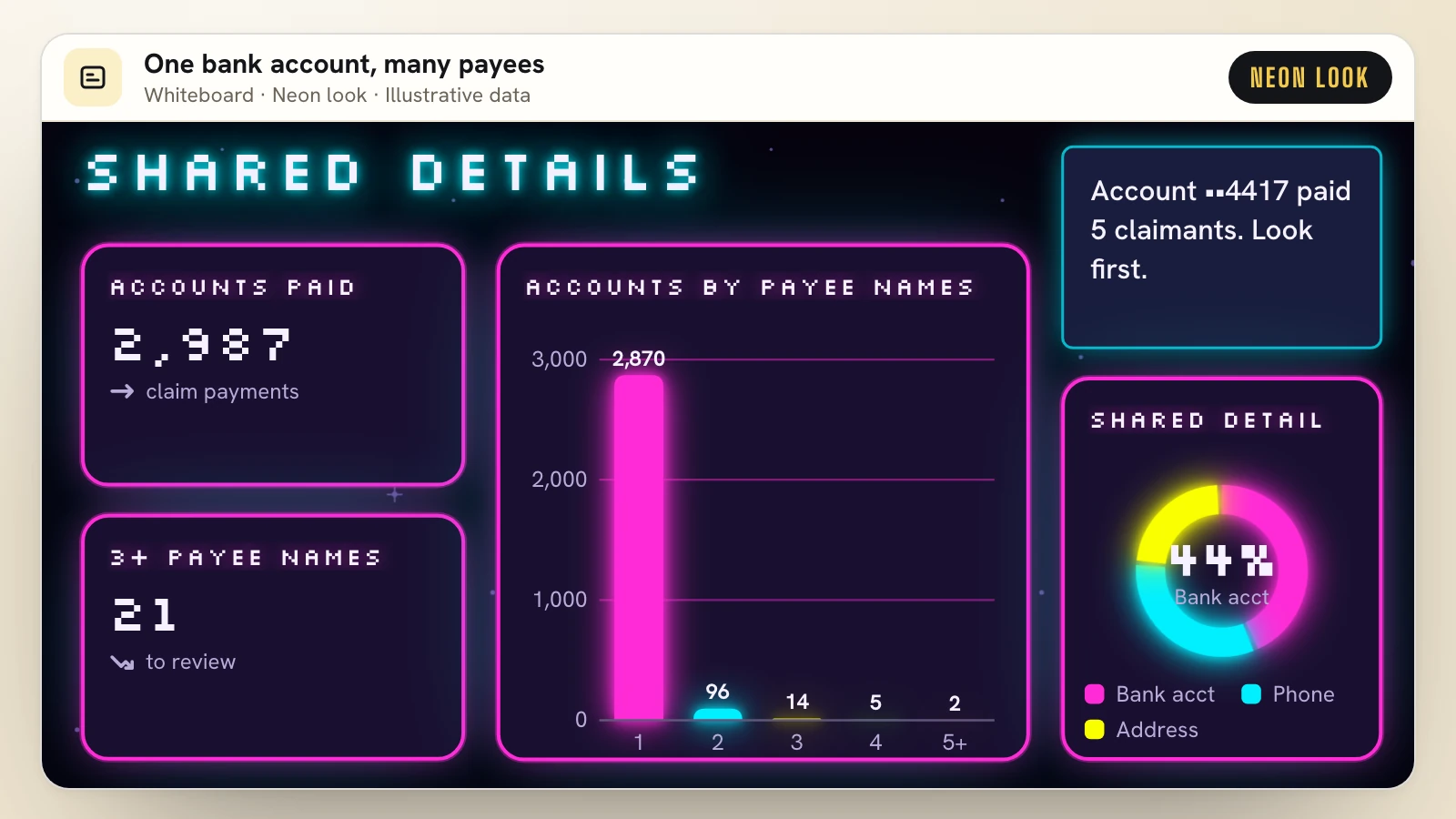
You ask: Which bank accounts received claim payments under more than one payee name this year?
What Storek did
Linked payments to claims
Matched each payment in the billing ledger to its claim by claim number, and each claim to its policy by policy number.Cleaned before comparing
Stripped spaces and dashes from account and phone numbers, standardised addresses, and grouped payee names that differ only by initials or order.Masked everything personal
Names, accounts, phones and addresses were masked on arrival; the comparison ran on masked values.Counted names per account
For each account, counted how many distinct payees it was paid under, and on how many unrelated policies.
The answer
Twenty-one accounts were paid under three or more names. That is a short, readable list, and the place to start.
Dig deeper: how Storek found this
Sources linked. Billing payments, the claims list, the policy file and the claimant contact export. Payments carry the claim number; claims carry the policy number; contacts carry the claim number too. Each link was tested on its values before use.
Duplicates and variants. Account numbers were compared after removing formatting. Payee names such as “R. Okafor”, “Okafor Ruth” and “RUTH OKAFOR” were grouped as one name, so an account paid to one person spelled three ways is not counted as three. Addresses were standardised so “Flat 2, 14 Mill Rd” and “14 Mill Road Apt 2” match.
Peer comparison. Accounts were compared with what is normal for the book: most accounts receive money under one name, a few under two (households). Three or more is unusual here.
What was masked. Every name, account, phone and address. Investigators see “Account A: 4 payee names, 5 policies” and can reveal the underlying details only with permission, field by field, and each reveal is logged.
Drilling down. Click the bar for three names and the accounts open as a list. Click an account and you see each payment, its claim, policy, adjuster and the notes, in date order.
For analysts
Run the same count for phones, emails and addresses, then look for claims connected by two or more different kinds of shared detail. One shared phone is common. A shared phone and a shared account between two “unrelated” claimants is much rarer.
Shared phones and addresses
You ask: Which phone numbers appear on claims for three or more different claimant names?
The same steps, run on phones, gave Priya’s team this:
| Phone (masked) | Claimant names | Policies | Explained? |
|---|---|---|---|
| Phone A | 6 | 6 | Body shop front desk |
| Phone B | 4 | 4 | Not yet explained |
| Phone C | 3 | 2 | Same household |
| Phone D | 3 | 3 | Not yet explained |
Two of the four were explained in minutes. Two went to the special investigations unit with their claims attached.
Steps to run this on your claims
- List the details you can compare: payee account, phone, email, address.
- Clean before matching. Most missed matches are formatting, not fraud.
- Count names per detail, not details per name.
- Write down the innocent explanations you find (households, shops, brokers) so they are excluded next time.
- Look for claims linked twice, by two different details. Those are the strongest leads.
This check is one of the red flags in reading claims fraud red flags across systems, and it works best in that wider picture.
Keeping personal data safe while you look
Comparing contact details sounds like the opposite of privacy. It need not be. Because the details are masked before anyone looks, the team works with links, not personal data. Read more on how masking works.
This is the everyday work Storek does for insurers: it links policies, claims, billing and notes, masks personal data, and flags patterns for a person to review. See how it fits financial services.