Platform how-to · Banking and credit unions
What to bring to a fraud review: a checklist for claims and SIU teams that gets to a fair decision
A fraud review goes well or badly before anyone sits down. The flag starts the conversation; the file someone brings decides whether the room can reach a fair decision.
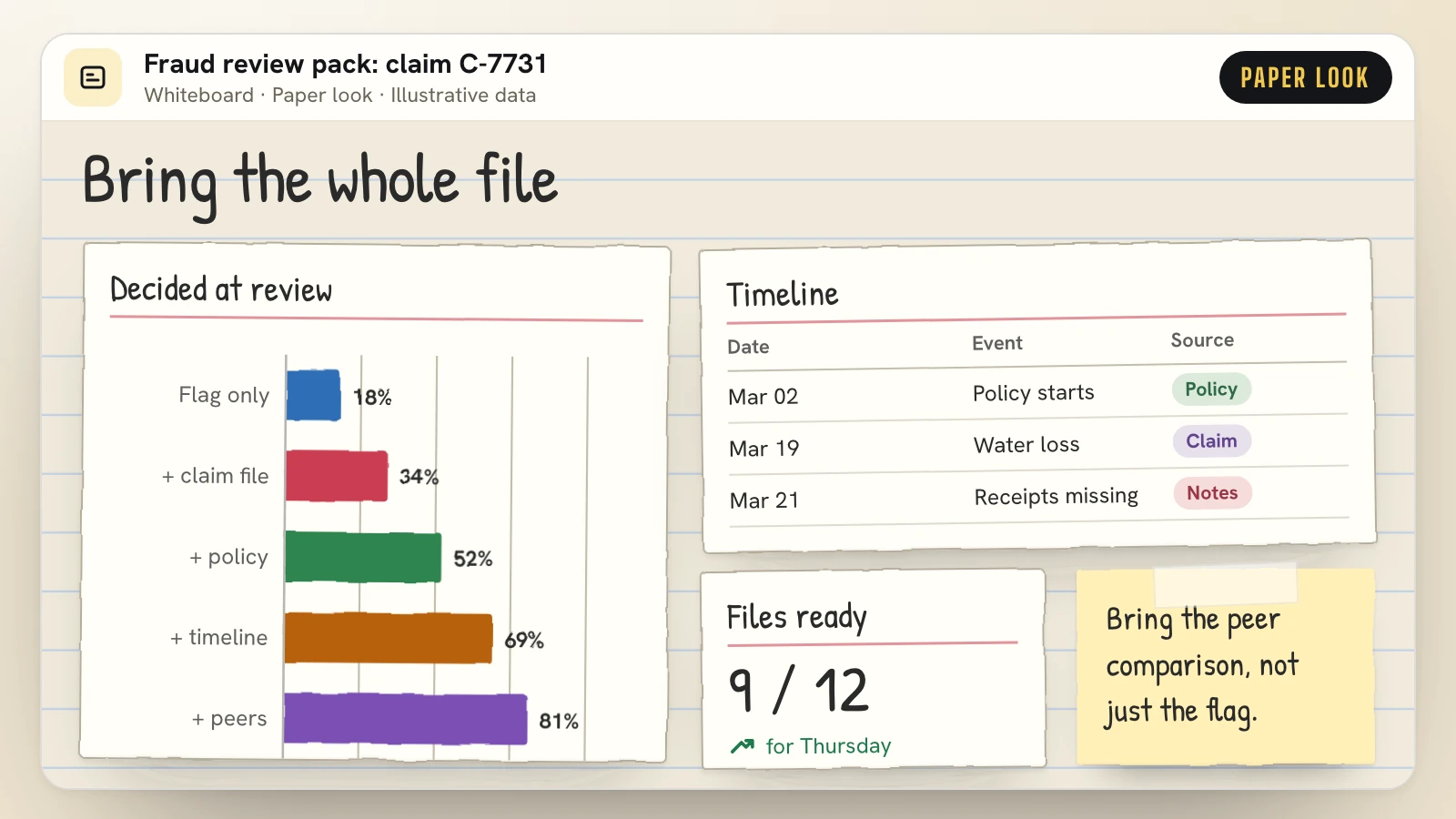
At Fenwick Shore Assurance, a fictional auto and small-business carrier, fraud reviews used to go the same way. Someone brought a printout of the flag. Someone else remembered the claimant had “another claim a while back.” Twenty minutes went on finding the policy history. The meeting ended with “let’s look into it” and no owner.
Claims director Okonkwo changed one thing: no flag comes to review without a prepared file. Here is what goes in it.
The checklist
The flag and its reason, in a sentence
What fired, compared with what, and why it was raised. If no one can say why, it is not ready for review.
The claim file
Claim details, payments, payees, reserves and their changes.
Linked policy and billing history
Start date, every change and when, lapses and reinstatements, how premiums were paid. See linking policy, claims and billing.
A timeline with the notes
Every dated event on one line, adjuster notes attached where they fall.
A peer comparison
How this claim compares with similar claims by type, size and region.
Shared details with other files
Phone, address, bank account, vehicle, repair shop or clinic shared with other claims.
Innocent explanations considered
A short note on the ordinary reasons the pattern could appear, and whether they were checked.
Preparing a file in minutes
You ask
Prepare the review file for claim FS-2218: policy and billing history, timeline with notes, similar claims and anything it shares with other files.
What Storek did
- Linked the claim to its policy, billing, payments and notes by policy and claim number.
- Compared it with commercial vehicle claims of similar size in the same region.
- Matched its phone, address, payment account and repair shop against all other claims.
- Masked every personal detail in the file.
The answer
| Section | What it shows |
|---|---|
| Flag | Severity well above similar claims in the region |
| Policy and billing | Vehicle added 9 days before loss; premium paid on time |
| Timeline | Loss, tow and estimate within one day; notes consistent |
| Peers | Repair estimate high, but in line with this vehicle model's parts |
| Shared details | None with other claims |
| Innocent explanations | Newly added vehicle is a newer, costlier model |
Once peers are matched on vehicle model, the high severity is explained. The review closes the flag with a reason in five minutes.
Dig deeper: how Storek found this
Sources linked. The claim to its policy by policy number; the policy’s endorsement history to show when the vehicle was added; billing by account number; payments and repair estimates by claim number; adjuster notes by the claim reference in the text.
Duplicates and variants. Shared-detail matching compared phones, addresses and accounts after evening out formats, and checked name variants only alongside another shared detail, never on name alone. Nothing matched.
Peer comparison. The first comparison used claim type and region. The second added vehicle model and year, which is the comparison that explained the severity. Both are shown so the room can see how the picture changed.
Masked. The claimant, driver and payee stayed masked throughout. No field needed revealing for the decision.
Drilling down. Each row of the file opens to its records: the endorsement, the payments, each note, and the list of peer claims behind the comparison.
For analysts
The peer group is the set of closed claims with the same coverage, region and vehicle class, from the last two years. The claim is placed by where its amount falls within that group, so “well above” means above nearly all of them, and the group size is shown so a thin comparison is visible.
What a prepared file changes
You ask
For reviews this year, how often did the meeting reach a decision, by how the file was prepared?
What Storek did
- Linked each review to the contents of its file and its recorded outcome.
- Grouped reviews by the most complete layer included.
The answer
Reviews with the full file reached a decision far more often than those with the flag alone. Preparation, not discussion, is what moved the outcome.
In the room
Put the file on one screen so everyone reads the same thing. A whiteboard works well: the timeline, the peer chart and the shared-details table side by side. Decide, record the reason, name the owner of any next step. For more on working leads, see SIU data tips; for why ordinary explanations matter, fraud flags, false positives and fairness.
How Storek fits
Storek links policies, claims, billing and adjuster notes so a review file assembles from one question, masks personal data with field-by-field reveal for those with permission, and flags patterns for a person to review. Every part of the file shows how it was found. See security and financial services.