Public sector and education: screening purchase orders for splits under the bid threshold
When a purchase that should have gone to bid shows up as three orders just under the limit, it's usually visible in the PO export. Here's how to screen for it, what the federal rule says, and why every flag still needs a person.
Storek team··4 min read
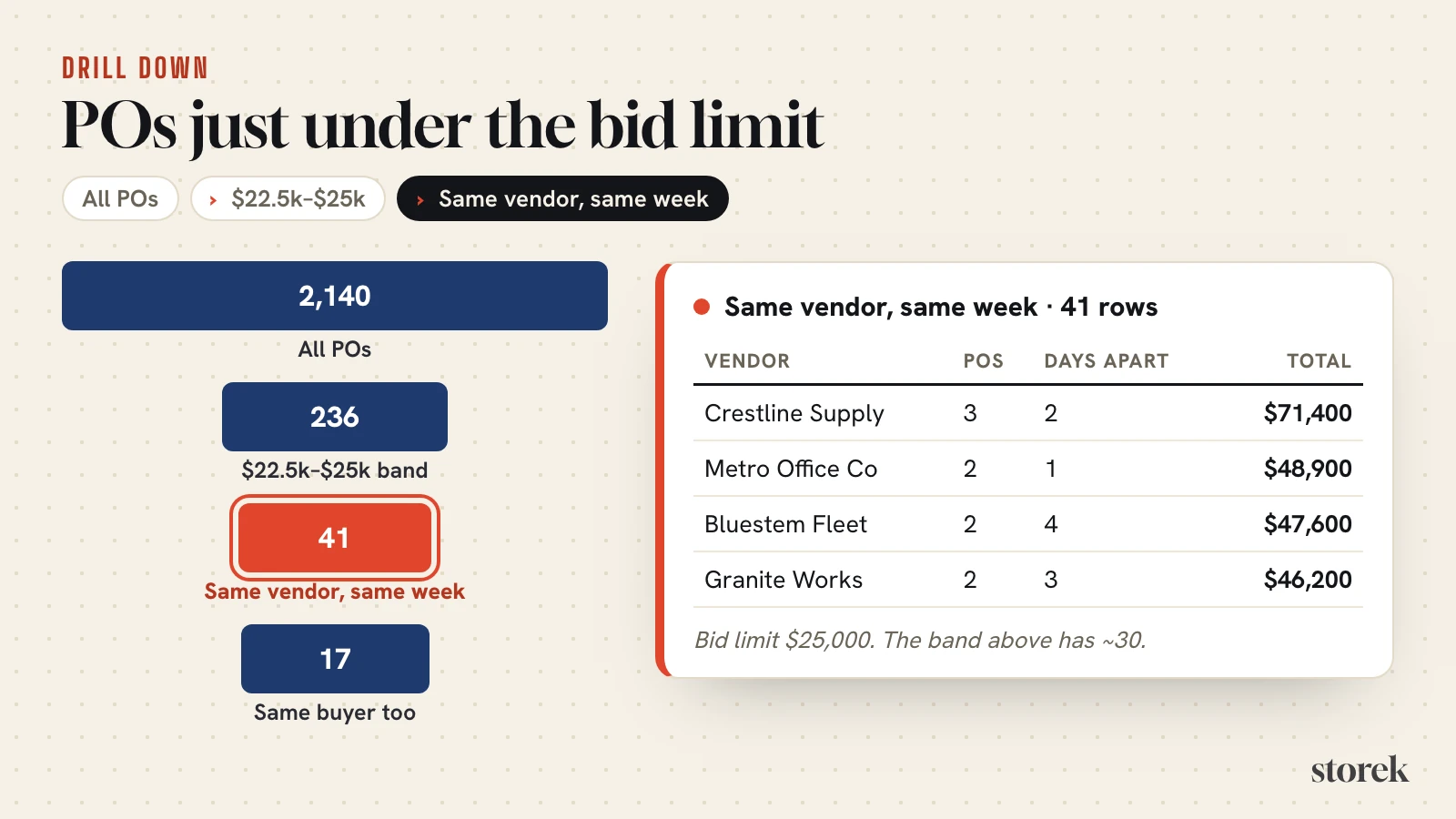
Sample dataDrilling into purchase orders that sit just under the bid limit. Illustrative data.
Every public buyer has a number that changes the paperwork. Under it, a purchase order and a quote or two. Over it, a formal bid, a public notice and weeks of process. That number creates a temptation: a $60,000 need becomes three orders of $20,000.
Most of the time, nobody sets out to break a rule. A department needs equipment before the school year starts, and the bid calendar doesn’t fit. But the pattern looks the same in the data either way, and it’s the kind of thing a board member, an auditor or a local reporter will eventually ask about.
What the rule says
For federal purchases, the Federal Acquisition Regulation sets the micro-purchase threshold at $15,000 and the simplified acquisition threshold at $350,000 (FAR 2.101, as of November 9, 2026). FAR 13.003(c)(2) says not to break down requirements that add up to more than one of those thresholds into several purchases below it, merely to stay under. The FAR overhaul under way in 2025 and 2026 carries the same idea into its rewritten Part 13 for agencies using the new text.
States, cities, counties and school districts set their own thresholds and their own anti-splitting rules. Before you screen anything, write down the threshold that applies to your organization. In this article’s invented example, a school district requires formal bids for purchases above $25,000.
Two signals in the PO export
A split leaves two kinds of trace in a purchase-order export.
A pile-up just under the threshold. Order amounts usually thin out smoothly as they get bigger. A spike in the band right below the limit, followed by a cliff right above it, is the first sign. The chart at the top of this page shows it: 236 orders between $22,500 and $25,000, against 117 in the band below.
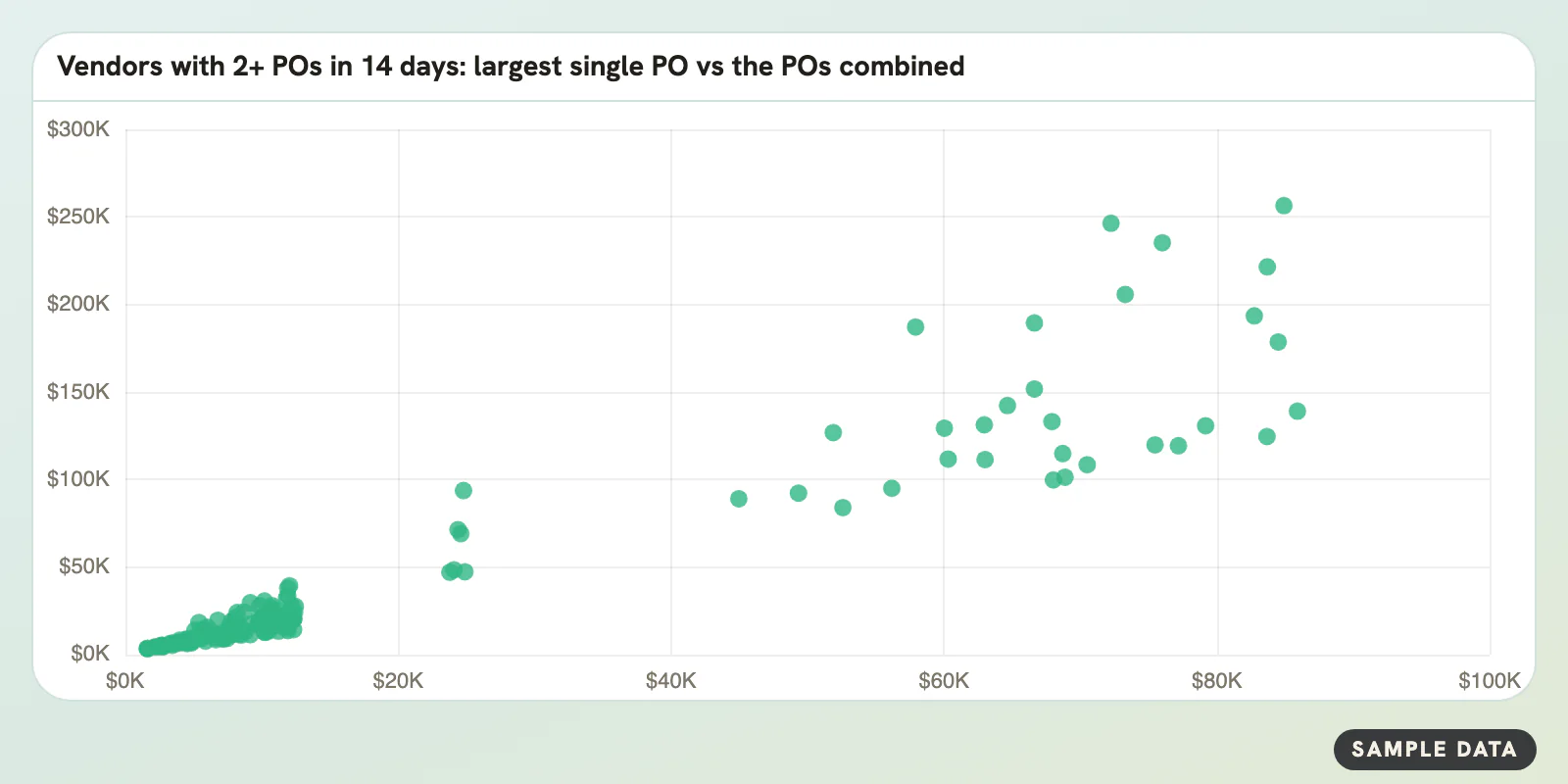
Clusters that add up. Several orders to the same vendor, close together in time, each under the limit, together over it. Plot each vendor’s cluster by its largest single order and its combined total. Clusters whose largest order sits just under the limit while the total is two or three times it are where to look first.
Sample dataEach dot is a vendor with two or more orders in 14 days. The tight group just left of $25,000 on the horizontal axis, with totals two to four times the limit, is the review list. Invented data.
The screen, step by step
Load the PO export with vendor IDs
Use the export with a vendor ID, not just a vendor name. “Acme Supply,” “ACME Supply Inc.” and “Acme Supply Co” are one vendor that a name-based screen sees as three. Storek checks every load’s row count against the source, so a short export doesn’t make a short screen.
Draw the distribution around the threshold
Ask for purchase orders by amount band, in narrow bands around your limit. Pin it. If there’s no pile-up, the next steps will be quiet too.
Find clusters per vendor in a window
Group orders by vendor within a rolling window, often 14 or 30 days. Keep clusters where every order is under the limit and the total is over it.
In Storek
You ask
“Which vendors got several orders just under the bid limit within two weeks?”
What Storek did
grouped purchase orders by vendor in rolling two-week windows
kept clusters where each order is under the limit but the total is over it
listed each cluster with its orders, dates and requesters
The answer
A short list of clusters worth a second look, each one traceable to the individual orders.
Dig deeper: see how it works
Storek matched vendors that appear under slightly different names, used your bid limit as your team defined it, and lets you drill from each cluster to the orders behind it.
For analysts
SELECT a.vendor_id, a.po_number AS first_po, COUNT(*) AS pos_in_window, MAX(b.amount) AS largest_po, SUM(b.amount) AS combinedFROM purchase_orders aJOIN purchase_orders b ON b.vendor_id = a.vendor_id AND b.po_date BETWEEN a.po_date AND a.po_date + INTERVAL '14 days'GROUP BY a.vendor_id, a.po_numberHAVING COUNT(*) >= 2 AND MAX(b.amount) < 25000 AND SUM(b.amount) > 25000;
Add the context that separates splits from coincidences
Same requester? Same department? Same commodity code? Consecutive PO numbers, or the same day? A cluster of three laptop orders from one requester in one week reads differently from three unrelated orders to an office-supply vendor from three schools.
Work the list as a review queue
Put the flagged clusters into a review table with a status for each (Open, Accepted, In progress, Done) and a column for the reviewer’s note. Next month’s export re-runs the same checked queries and brings new clusters in.
Table · reviewPossible split purchases, Q1
VendorPOs in 14 daysCombinedStatus
V-1047 · classroom tech4 POs$93,500Open
V-2213 · grounds services3 POs$71,200In progress
V-0388 · furniture3 POs$68,900Review
V-1530 · printing2 POs$48,200Dismissed
Your columns: notes + a formulaPublish approved rows → dataset
Records stay private along the way
Purchasing data sits next to people: requester names, vendor contacts, and in a district, student and staff records in other tables. Storek detects personal data when files land and masks it whenever anyone reads it. Reveal grants go per person and per field, so the auditor can see a requester’s name while the budget office sees counts, and the audit log records which labels were read and how many, never the raw values.
Breaking one requirement into several smaller purchases so each stays under a threshold that would otherwise require quotes or a formal bid. The federal rule, FAR 13.003(c)(2), tells buyers not to break down requirements that add up to more than a threshold merely to stay under it.
What are the federal purchasing thresholds?
As of November 9, 2026, the Federal Acquisition Regulation sets the micro-purchase threshold at $15,000 and the simplified acquisition threshold at $350,000 (FAR 2.101). State, local and school district thresholds are set by their own laws and policies and are often different.
Is every cluster of small orders to one vendor a split?
No. Blanket orders, separate funding sources, genuinely separate needs and emergencies all produce clusters. The screen produces a review list; a person decides what each cluster was.
Can the screen run every month?
Yes. Once the questions are pinned as a dashboard and a review table, each new purchase-order export re-runs the same checked queries, and new clusters arrive in the review queue.
Book a demo
See your own data, delivered.
30 minutes. Your data or our sample. No slide deck. Pick a time straight after the form.