Platform how-to · Banking and credit unions
Duplicate invoices in insurance claims: how to find repeats, near-repeats and the same bill on two claims
Most duplicate invoices are honest mistakes, a supplier resending a bill or two handlers keying the same one. A few are not. Both cost money, and both are findable.
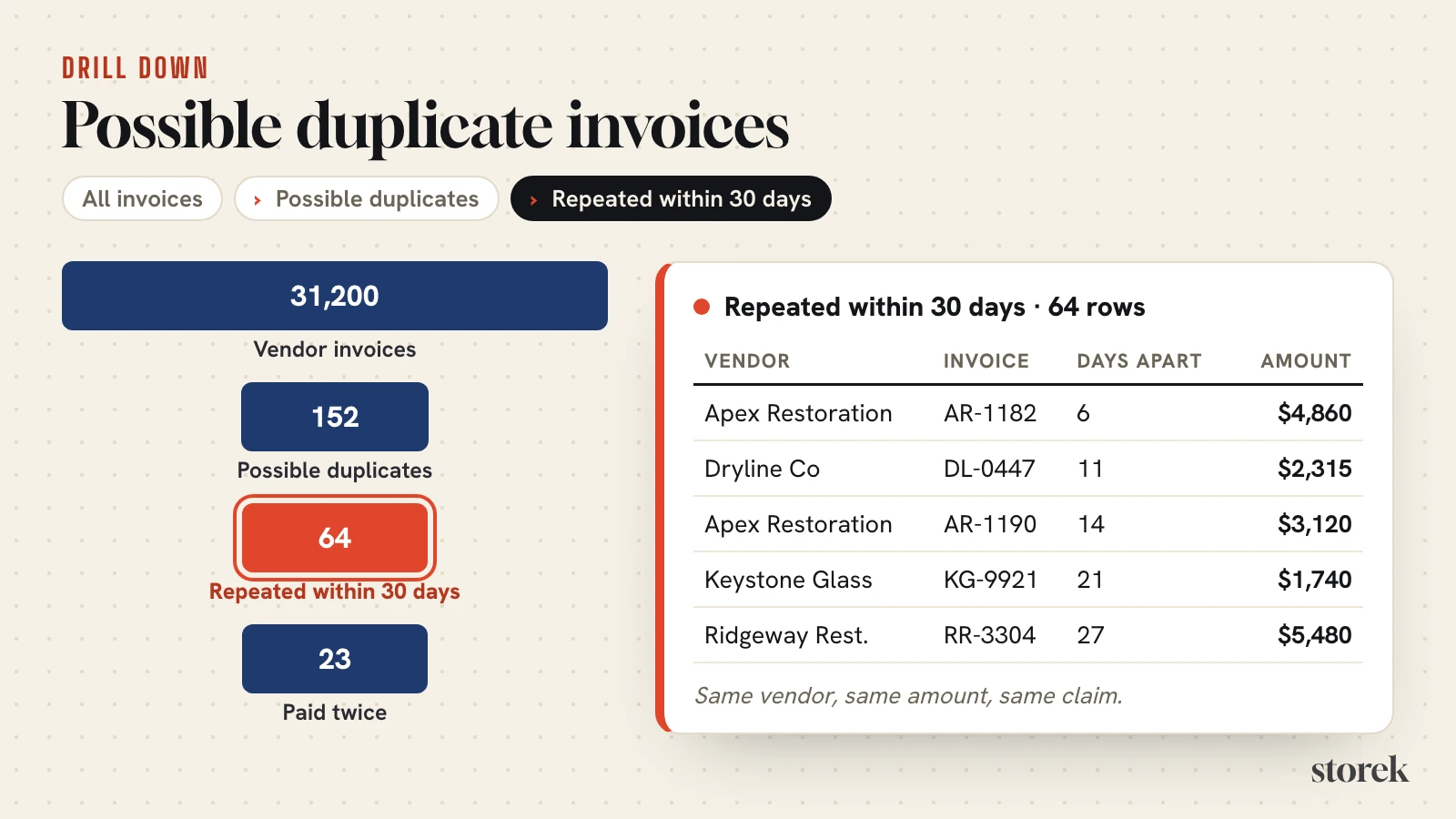
Ashcombe Motor & Home pays tens of thousands of supplier invoices a year: tow trucks, body shops, glaziers, plumbers, hire cars. Its claims finance lead, Tomasz Wilde, already runs a duplicate check. It catches the same vendor, same amount and same invoice number. Every year an auditor still finds a few duplicates it missed, and every year Tomasz wonders how many more there are.
Why exact checks miss duplicates
An exact check needs every field to match. Real duplicates rarely do. The second copy arrives as “Northgate Autobody Ltd” instead of “Northgate Auto Body”, with invoice 10482 instead of 10481, three weeks later, on the claim for the passenger instead of the driver. Each difference is small. Together they hide the repeat.
Looking for near-repeats
You ask: Which claim invoices in the last year look like repeats of another invoice, even when the vendor name, number or claim differs?
What Storek did
Linked invoices to claims
Matched each payment to its claim by claim number, and each claim to its policy by policy number.Grouped vendor names
Treated vendor names that differ only in spacing, punctuation, “Ltd” or “Inc” as the same vendor, and checked each grouping against bank details on the vendor record.Compared each invoice with its neighbours
Looked for same amount and vendor within 30 days, invoice numbers one apart, and identical line items on different claims.Masked the people
Claimant names and bank details were masked before any comparison.
The answer
The exact check already caught 38. The other 114 are possibles, and 29 of them come from name variants and bills spread across two claims.
Dig deeper: how Storek found this
Sources linked. The payment ledger, invoice line items, the vendor master and the claims list. Invoices connect to claims by claim number and to vendors by vendor code or, where the code is missing, by name and bank details.
Duplicates and variants. Vendor names were compared after removing spacing, punctuation and company suffixes. Two names were grouped only when they also shared a bank account or tax number, so two genuinely different “Smith Plumbing” firms stay apart.
Peer comparison. Each vendor’s rate of near-repeats was compared with other vendors of the same type, so a high-volume tow firm is not flagged just for sending many bills.
What was masked. Claimant names, addresses and all bank account numbers. Vendor business names stay visible; their account numbers are masked too.
Drilling down. Click any bar to open the pairs side by side: both invoices, their claims, amounts, dates and line items, with what matched and what did not highlighted.
For analysts
Score each pair by how many fields agree: vendor group, amount, date gap, invoice number gap and line items. Review pairs where most fields agree first. Pairs on two claims under the same policy are often legitimate splits (driver and passenger), so check the policy before calling them repeats.
Which vendors repeat
You ask: Which vendors have the most possible repeats, compared with others of their type?
| Vendor type | Vendor | Possible repeats | Typical for type |
|---|---|---|---|
| Body shop | Vendor 14 | 11 | 1 |
| Tow | Vendor 3 | 6 | 2 |
| Glazier | Vendor 22 | 4 | 1 |
| Hire car | Vendor 9 | 3 | 3 |
One body shop stands far apart from its peers. That is a conversation to have, starting with the invoices themselves.
Five steps to a better duplicate check
- Keep your exact check. It is cheap and catches the obvious.
- Group vendor names, but confirm groups with bank or tax details.
- Loosen one field at a time: date window, invoice number gap, claim.
- Compare vendors with their own type, never with the whole book.
- Recover first, investigate patterns second. Most duplicates are errors.
Shared bank details are explained further in same phone, different claimant, and early-loss timing in claims soon after a policy starts.
A near-repeat, step by step
Here is an illustrative case from Tomasz’s ledger. A roofing contractor billed $4,850 for claim A on 3 March, invoice 1187. On 9 March, a vendor spelled slightly differently billed $4,850 for the same claim, invoice 1189. The exact check passed both, because the names and numbers differed. The near-repeat list caught them together: same claim, same amount, invoice numbers two apart, six days between them, and the same bank details behind both names.
Tomasz’s team called the contractor before paying. The second invoice had been sent by a new office assistant who did not know the first had gone out. The contractor withdrew it the same day, and the team added the second spelling to the vendor’s group so it would match next time. No investigation, no accusation, just one payment instead of two.
Paying once
Tomasz now runs the near-repeat list before each weekly payment run, with the full ledger kept in one place in the data lake. Storek links policies, claims, billing and notes, masks personal data, and flags patterns for a person to review. See how it fits financial services teams.