Industry analysis · Banking and credit unions
Missed subrogation: how to find recoveries left behind in closed claims, using the notes nobody re-reads
When another party caused a loss, the carrier can often recover what it paid. The clue that a recovery was possible usually sits in a note, and the claim closes without anyone acting on it.
Westmere Mutual’s recovery team is three people. They pursue whatever adjusters refer to them, and they are good at it. Their manager, Owen, has a nagging question: how many claims should have been referred and never were?
The answer is in the adjuster notes. “Rear-ended at the lights by a delivery truck.” “Fire started in the neighbour’s unit.” “Roofer left the tarp loose.” Each of those is a possible recovery. In most claim systems, none of them is a field.
Why subrogation slips through
Subrogation depends on one judgment: did someone else cause this? Adjusters make that judgment in the moment and write it in a note. If the referral step is skipped, because the claim was small, the adjuster was busy, or the claim moved between desks, the note stays and the referral never happens.
A recovery report only counts referrals. It cannot count what was never referred.
Reading closed claims for another party at fault
You ask
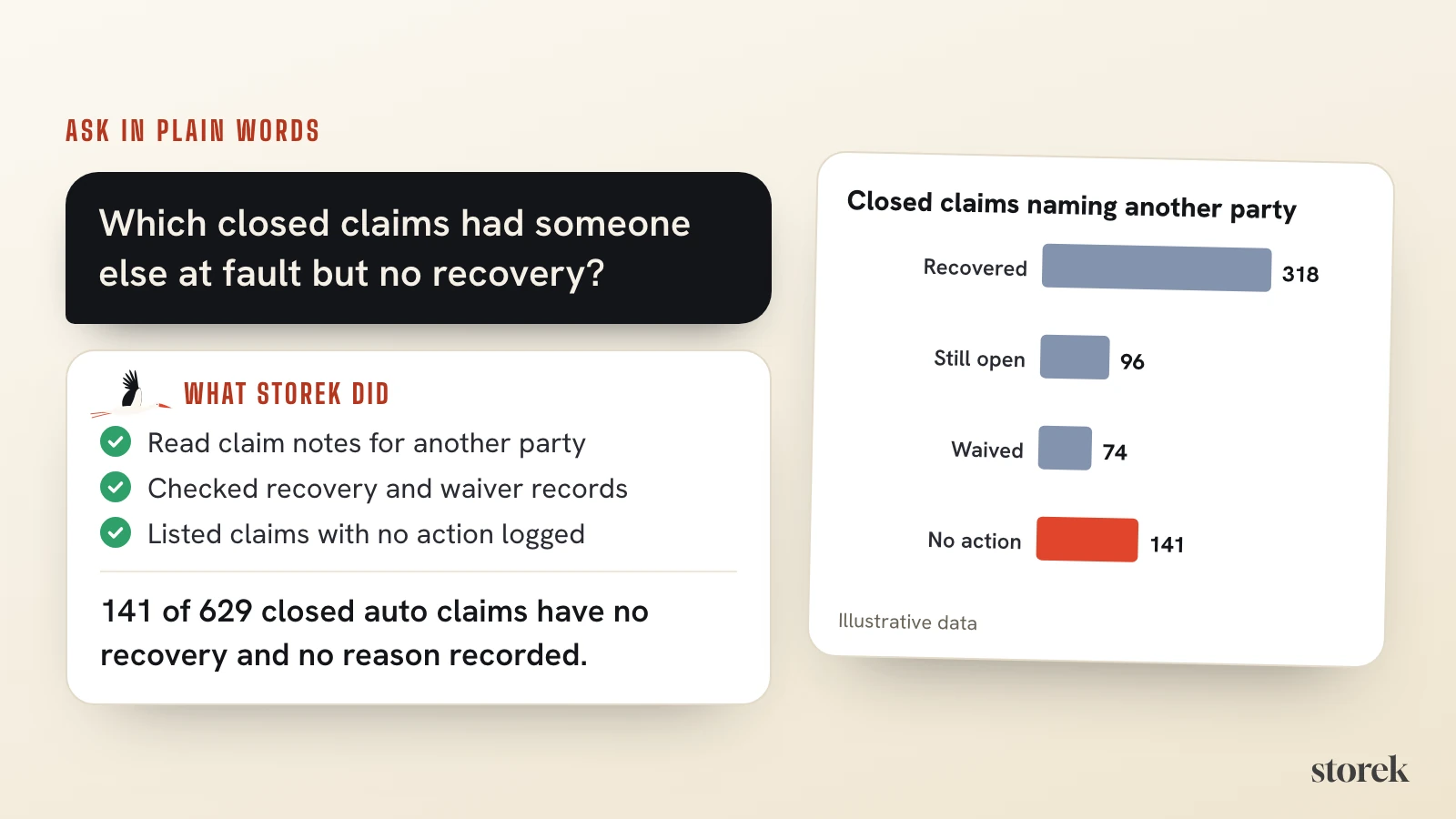
Which closed auto claims mention another party at fault in the notes but have no recovery or waiver recorded?
What Storek did
- Read the adjuster notes on closed auto claims for mentions of another driver, vehicle, business or contractor causing the loss.
- Matched those claims to the recovery ledger and the waiver log by claim number.
- Kept only claims with no recovery, no open pursuit and no logged waiver.
- Masked names, plate numbers and addresses in the notes.
The answer
Of 629 closed claims whose notes name another party, 141 show no action at all. They became the recovery team’s review list, sorted by amount paid.
Dig deeper: how Storek found this
Sources linked. The closed-claims export, adjuster notes, the recovery ledger, the waiver log and the payments ledger. Notes joined to claims by claim number; recoveries and waivers joined the same way; payments gave the amount at stake.
Duplicates and variants. Notes called the other party many things: “TP”, “third party”, “other driver”, “the van”, a company name. Storek treated these as one idea, and grouped claims that named the same other business under one masked reference, so a firm causing repeated losses showed up as one row.
Peer comparison. The share of claims with no action was compared across offices and claim sizes. One office’s small claims had far more gaps than the rest, which pointed to a process step rather than individual adjusters.
Masking. Names, plate numbers, phone numbers and addresses in notes were masked on arrival; the fault description stayed readable.
Drill down. From the “no action recorded” bar to the list of claims, then to each claim’s notes with the sentence that mentions the other party highlighted, beside the payments.
For analysts
Each note was classified for “another party caused the loss”, with the supporting sentence kept, so a reviewer can accept or reject the reading in seconds. Claims where fault was disputed or shared were labelled separately rather than dropped.
Beyond auto
The same reading works on property and liability claims. Look for contractors, landlords, neighbours, product failures and utilities in the notes. Property notes often name a part that failed, which is also how text clues in adjuster notes are found.
Pick a closed period
Start with claims closed recently enough that recovery is still possible. Check limitation periods first.
Read notes for another party
Find mentions of another driver, business, contractor or product causing the loss.
Match to recovery records
Remove claims already recovered, pursued or waived with a reason.
Sort by value and time left
Put the largest payments with the least time remaining at the top.
Fix the step, not only the claims
If one office or claim size misses referrals more often, change the closing checklist there.
Missed recoveries and fraud
Missed subrogation is mostly about money left on the table, but the two overlap. When the same other business appears in many claims, it may be careless, or it may be part of a pattern worth a look. See repair-shop and provider rings, and keep an eye on reserve anomalies on claims where a recovery was expected.
How Storek helps
Storek links claims, notes, payments and recovery records by the values they share, reads notes for what they say, masks personal data on arrival, and flags claims that look recoverable so a person can review them. Ask in plain words on Ask, share the review list with Deliver, and see the financial services page.