Industry analysis · Banking and credit unions
Repair shop and provider rings: how to see the network behind auto claims that look fine one at a time
A single auto claim with a body shop invoice and a clinic bill is ordinary. Forty-seven claims that share the same shop, the same clinic and the same tow firm are a pattern worth a person's time.
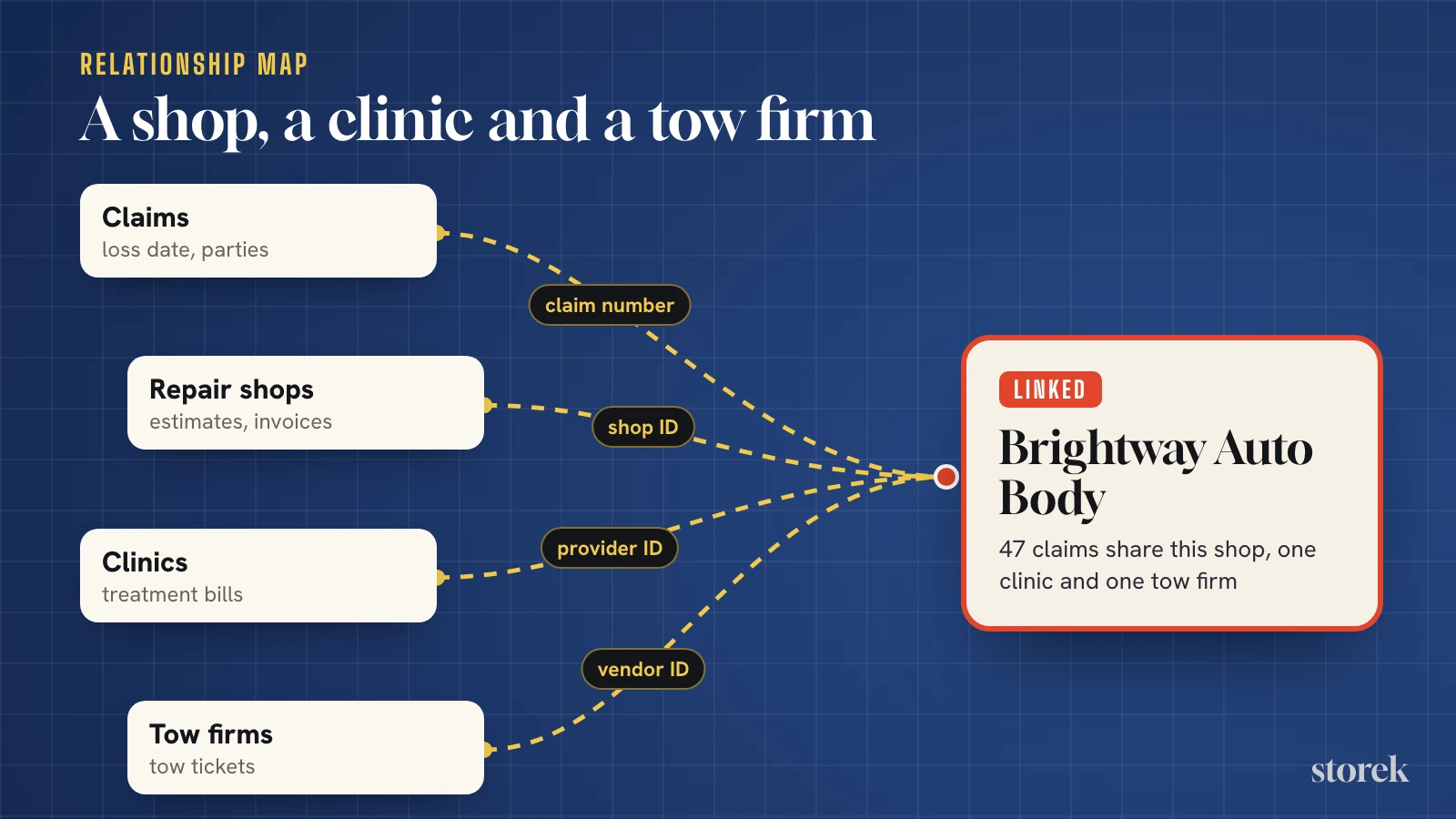
Teodora runs the auto special investigations unit at Copperline Insurance, a fictional regional carrier. Her adjusters keep mentioning the same body shop in the north of the metro area. Nothing on any single file is wrong. The estimate is reasonable, the clinic bill is within norms, the tow invoice is typical. Yet something feels rehearsed.
Rings work precisely because every piece looks fine alone. The signal is in who keeps turning up together.
Why rings hide in plain sight
A repair estimate sits in the claims system. Medical bills sit in a bill review tool. Tow and storage invoices arrive as attachments. Attorney letters are scanned into the file. Each party is spelled however the person typing it chose: “Brightway Auto Body”, “Brightway Body Shop”, “BRIGHTWAY AUTO LLC”.
So the question “which businesses keep appearing together?” can’t be asked, because nothing connects them. The first job is linking, not judging. For a wider view of the signals that hide between systems, see claims fraud red flags across systems.
Finding the network
You ask: “Which repair shops share claims with the same clinic and the same tow firm more than you’d expect?”
What Storek did
- Linked claims to estimates, medical bills and tow invoices by claim number.
- Matched business names that are spelled differently but share a tax ID, phone or address, so “Brightway Auto Body” and “BRIGHTWAY AUTO LLC” count as one shop.
- Counted, for each shop, the claims where the same clinic and tow firm also appear on at least two other claims, and compared that with other shops in the same area.
- Masked claimant names, phones and addresses throughout.
The answer
One shop, Brightway Auto Body, shares a shop, clinic and tow trio on 47 claims. The next shop has 9. Takeaway: Brightway’s network is about five times denser than its neighbours’, which is a reason to look, not a conclusion.
Dig deeper: how Storek found this
Sources linked. Claims, repair estimates, medical bill lines, tow and storage invoices and the attorney field on the claim, joined by claim number. Policies joined by policy number add the policy start date and the agency.
Name variants. Businesses were grouped when they shared a tax ID, a phone number or a street address, even if the names differed. Each grouping lists the evidence, so an investigator can split a wrong match in one sentence.
Peer comparison. Each shop was compared with shops in the same ZIP-code area and of similar claim volume, so a large shop isn’t flagged just for being large.
Masked. Claimant names, phones, addresses and bank details are masked. Business names stay visible because they are the subject of the review.
Drilling down. Click the Brightway bar to see the 47 claims, then any claim to see its estimate, bills, invoices and the adjuster’s notes, with claimant details still masked.
For analysts
Treat each claim as a meeting point between parties. Two parties are linked when they share a claim; a trio counts when all three appear on the same claim and that combination recurs. Ranking by recurring trios rather than raw shared claims keeps busy, honest businesses lower on the list.
Steps for your own ring review
List every party on a claim
Shop, clinic, tow, rental, attorney, public adjuster. Pull them from wherever they live, attachments included.
Unify business identities
Group spelling variants by shared tax ID, phone or address. Keep the evidence for each grouping.
Count recurring combinations
Pairs are noisy. Trios and quartets that repeat are far rarer by chance.
Compare with local peers
A shop is only unusual compared with similar shops nearby.
Hand a worklist to a person
Give investigators the claims, the parties and the evidence. They decide.
What else to check
Timing
Do the claims in the cluster share accident days, times or road types? Tight timing next to a dense network deserves more attention, and so do invoices that repeat across claims; see duplicate invoices in insurance claims.
Shared claimant details
Different claimants who share a phone or a bank account across the ring’s claims are a stronger signal than the businesses alone. See same phone, different claimant.
Where Storek fits
Teodora loads the claims, estimate, bill and invoice exports as they are. Storek links them by the values they share, matches name variants, masks personal data, and flags the clusters that stand apart from their peers, with every claim behind the flag one click away. Her team decides what each cluster means. See how this works for carriers on the financial services page, and how to ask these questions in plain words on Ask.