Industry analysis · Banking and credit unions
Premium leakage: how to find misclassified risk by reading claims, billing and policy data together
Premium leakage is the money a carrier never charges because a risk was rated as something it is not. The clues are rarely on the policy. They sit in claims, billing and notes that underwriting seldom reads.
Copperfield Commercial insures small-business vehicles. Its underwriting manager, Elena, keeps hearing the same story from the claims floor: a “local florist van” that turns out to do long-haul deliveries, a “contractor pickup” that tows heavy equipment every day. Each case gets fixed when someone notices. Nobody knows how many go unnoticed.
The policy system knows what the customer declared. The claims system and the adjuster notes know what the vehicle actually does. They had never been read side by side.
Why premium leakage is hard to see
Rating happens once, at quote. After that, the policy record rarely changes unless the customer asks. Meanwhile, claims capture odometer readings, garaging addresses, drivers and the purpose of the trip. Billing captures how many vehicles were added mid-term. Notes capture what the adjuster saw.
Every one of those is a clue about the true risk. None of them flows back to underwriting by default.
Comparing what was declared with what claims show
You ask
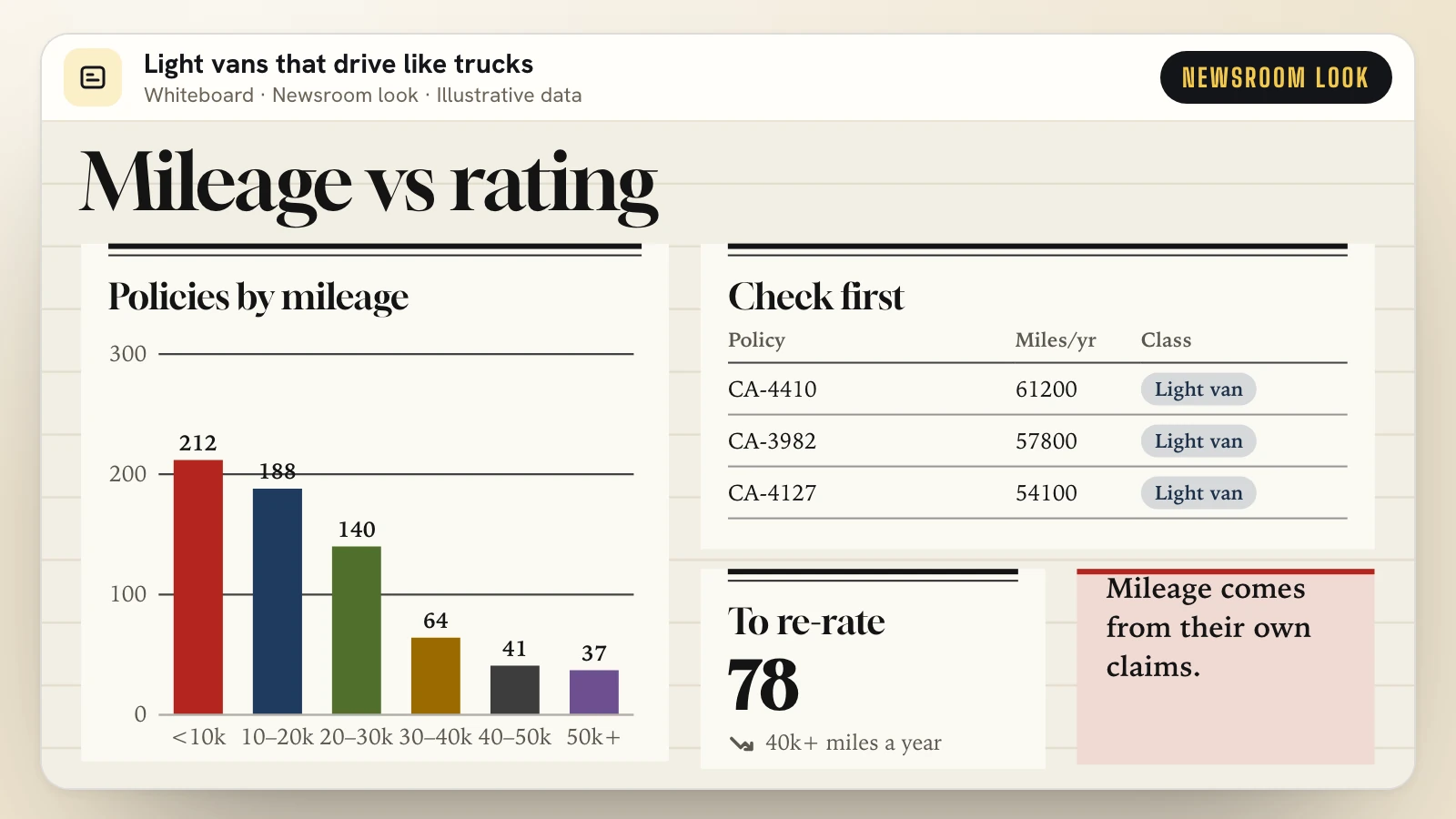
Which commercial auto policies rated as light local vans have claims showing high yearly mileage or long-distance trips?
What Storek did
- Matched each claim to its policy by policy number and vehicle identifier.
- Read odometer readings and trip descriptions from claims and adjuster notes, and turned them into yearly mileage per vehicle.
- Compared each policy’s mileage with others in the same rating class.
- Masked policyholder names, addresses and driver details.
The answer
| Yearly mileage from claims | Policies rated as light local vans |
|---|---|
| Under 30,000 | 741 |
| 30,000 to 40,000 | 64 |
| 40,000 to 50,000 | 41 |
| Over 50,000 | 37 |
Seventy-eight policies drive far more than their rating class suggests; underwriting now has a short list instead of a hunch.
Dig deeper: how Storek found this
Sources linked. The policy register, vehicle schedules, the claims export, adjuster notes and billing endorsements. Claims joined to policies by policy number, and to vehicles by vehicle identification number where recorded, or by registration where not.
Name variants. The same business appeared as “Bloom & Co”, “Bloom and Co Ltd” and a trading name. Storek grouped them by registered business number and address, showed the grouping for checking, and masked the names.
Peer comparison. Each policy was compared with others in the same rating class and region, so a rural class with naturally longer trips was not treated as an outlier.
Masking. Policyholder names, addresses, drivers and contact details were masked on arrival.
Drill down. From the high-mileage bars to the policies, then to each claim with its odometer reading and the note that described the trip, so the underwriter sees the evidence behind every row.
For analysts
Yearly mileage came from pairs of odometer readings on separate claims for the same vehicle, divided by the days between them. Vehicles with a single reading used the note’s trip description instead and were labelled as lower confidence.
Other places premium leaks
The same “declared versus observed” comparison works across lines:
- Garaging address. Claims and billing addresses in a higher-rated territory than the policy address.
- Business use. Personal auto claims that describe deliveries or rideshare trips.
- Payroll and headcount. Workers’ compensation claims from job roles the policy did not declare.
- Occupancy. Homeowner claims that mention tenants on a policy rated as owner-occupied.
- Mid-term changes. Vehicles or locations added in billing but never re-rated.
When a mismatch appears soon after inception, also check claims filed soon after a policy starts.
Pick one rating factor
Mileage, territory, use or occupancy. Start with the one your claims team complains about.
Find where the truth is recorded
Odometer fields, addresses, adjuster notes, endorsements. Gather those exports as they come.
Compare declared with observed
Line up each policy’s rating with what its claims and billing show, against peers in the same class.
Rank by premium at stake
Sort mismatches by how much the rating would change, so underwriting starts with the biggest.
Hand off and record
Underwriting checks each one and corrects at renewal. Record what was confirmed and what was explained.
How Storek helps
Storek links policies, vehicle schedules, claims, billing and adjuster notes by the values they share, masks policyholder data on arrival, and flags policies whose observed risk differs from their rating so an underwriter can review them. Ask on Ask, keep rating-class meanings in Definitions, and see the financial services page and our security approach.
Start with one product line and one season, check the first findings with your underwriters, and widen the review only once the team trusts what it sees.